Japanese Researchers Develop Hamster-Algae Hybrid Cells Capable of Dividing Over 150 Generations

Blending Two Distinct Life Forms
According to НВ — Техно: Scientists at the University of Tokyo have engineered a groundbreaking hybrid cell combining hamster and algae components, named 'planimals.' Remarkably, these hybrid cells have demonstrated the ability to divide consistently for more than 150 generations. This breakthrough may pave the way toward producing animal cells that can perform photosynthesis.
The hybrid was created by merging chromosomes from red algae with hamster cells. The study revealed that the foreign genetic material remained stable through the extensive cell divisions. Published in the respected journal Nature Communications, these findings mark a significant advancement in cellular biology.
Potential Impact on Ecology and Biotechnology
The goal of this research is to enable animal cells to harness photosynthesis, a development with far-reaching environmental and biotechnological implications. Notably, the single-celled organism Hatena arenicola, native to Japan, naturally forms a symbiotic relationship with algae, offering a real-world example of such interactions.
Researchers found that natural phagocytosis produced an efficiency of 3.7 colonies per 12 million cells. However, by applying polyethylene glycol techniques, they boosted this efficiency by 800 times. Despite these advances, only about 4% of the algal genes in the hybrid were actively transcribed. The project was led by Sachihiro Matsunaga, whose leadership has been instrumental in this scientific achievement.
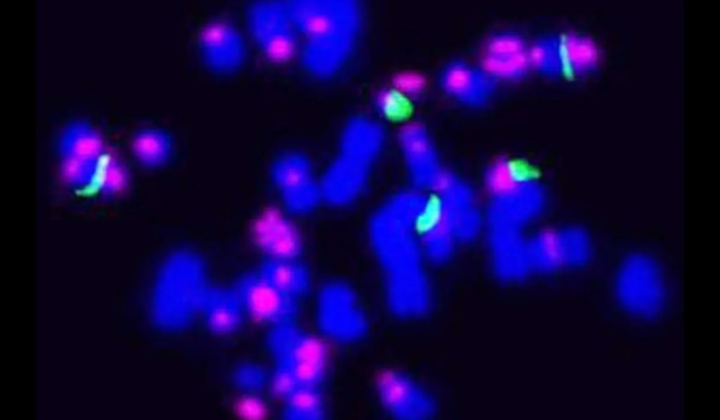
The photo of planimal chromosomes taken by Sachihiro Matsunaga will stand as a testament to the team's remarkable progress in 2026.
Successfully creating hybrid cells capable of sustained division opens new avenues for exploring cell biology and advancing biotechnological applications.
This innovation holds promise for addressing pressing environmental challenges by developing organisms that blend plant and animal traits. Photosynthetic animal cells could reduce reliance on conventional energy sources, offering a novel approach to improving global ecological health.

Read also