Oldest Known Cosmic Cannibalism Detected in the Milky Way by Astronomers

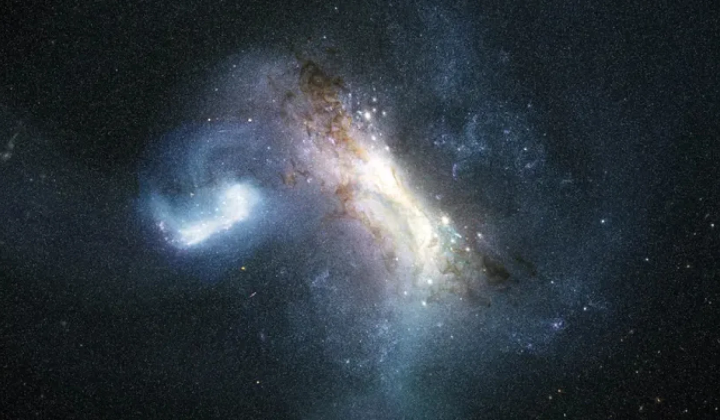
Signs of Ancient Galactic Cannibalism Uncovered
According to НВ — Техно: Using the Hubble Space Telescope, the ARMA project's astronomers have found what appears to be the earliest known case of one galaxy consuming another, taking place in the heart of our own Milky Way. Their hypothesis holds that, roughly 12 billion years ago, the Milky Way devoured a neighboring star system. That victim, designated LKH (Low-energy-Kraken-Heracles), weighed in at about 500 million solar masses. The bulk of its material ended up scattered within a 20,000-light-year radius of the galactic center.
Why This Discovery Matters
The finding marks a major step in the ARMA team's effort to piece together the Milky Way's life story. Earlier research had established a collision with the dwarf galaxy Gaia-Enceladus some 10 billion years ago. With the new data, scientists have now been able to sort the globular clusters near the galaxy's core into three categories based on their ages and metallicity. The third category appears to consist of leftovers from a previously unknown cosmic catastrophe.
Chiara Zerbinati, a co-author of the study, commented: "This work reveals what was happening to the Milky Way during its infancy. It illuminates the events that set the course for the rest of our galaxy's development. If one of humanity's greatest questions is about our origins, then we are offering at least a partial answer."
Since the modern Milky Way has a total mass of approximately 1.5 trillion solar masses, these results may considerably alter our current picture of its evolution. And the implications reach beyond our own galaxy; by analyzing ancient galactic collisions, astronomers can better understand the processes that shape large cosmic structures. The same methods may eventually help clarify what happened in other galaxies that experienced similar transformations.
Image credit: NASA, ESA, Joseph Olmsted.
This discovery not only sheds light on the Milky Way's early development but also prompts further questions about its current composition. For instance, recent estimates suggest that our galaxy may contain as many as 170 million black holes. Understanding these cosmic structures could provide additional context to the Milky Way's evolution and its interactions with other celestial bodies.

Read also