Unique Chemical Fingerprint Discovered in Interstellar Comet 3I/ATLAS Following Its Solar Encounter

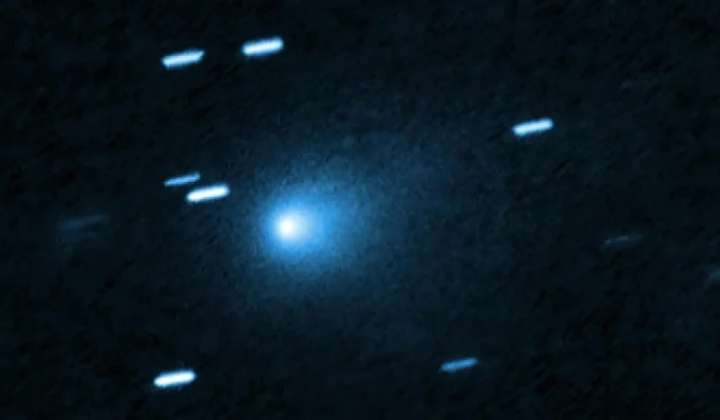
Insights into the Interstellar Comet 3I/ATLAS
According to НВ — Техно: Astronomers have analyzed the interstellar comet 3I/ATLAS, the third confirmed visitor from beyond our Solar System. After the comet’s closest approach to the Sun at the end of 2025, researchers studied its plasma tail and uncovered an extraordinary chemical composition. Notably, the comet exhibits an unusually high ratio of ionized nitrogen, indicating it formed in an extremely cold environment far from the warmth of its parent star.
Techniques and Key Findings
The plasma tail of 3I/ATLAS was examined using the WEAVE spectrograph mounted on the William Herschel Telescope in Spain. Scientists identified five distinct ion species within the tail:
- nitrogen
- carbon monoxide
- carbon dioxide
- water
- methylidyne
The remarkably high ionized nitrogen to carbon monoxide ratio supports the conclusion that the comet originated at temperatures below 30 Kelvin (around -243 °C), deep within the cold outskirts of its star’s protoplanetary disk. This finding aligns with previous detections of deuterium and unique isotopic markers typical of frigid star-forming regions.
Dr. Ruben Sanchez-Janssen highlighted: 'Sensitive blue-range spectrographs are ushering in a new era for studying interstellar travelers.'
These observations not only deepen our understanding of objects from beyond our Solar System but also shed light on the processes driving comet formation in remote and icy cosmic environments.
The study of 3I/ATLAS is significant for astronomy as it confirms the existence of comets formed under extreme conditions. The chemical insights gleaned from this research may illuminate early planetary formation mechanisms and the origins of water and organic compounds on Earth and other planets. Such discoveries are crucial for piecing together the complex puzzle of star and planet evolution across the galaxy.
As researchers delve deeper into the mysteries of celestial bodies, understanding the origins of elements in the universe remains crucial. Recent studies highlight the intricate processes involved in element formation during supernova explosions, which can provide valuable context for the findings related to interstellar comets like 3I/ATLAS. Discover more about these groundbreaking revelations in the field of astronomy and how they relate to the chemical processes that shape our universe by exploring new insights into elemental formation.

Read also