Black Hole the Size of a Ball Discovered by Astronomers

Star Flare in the Large Magellanic Cloud
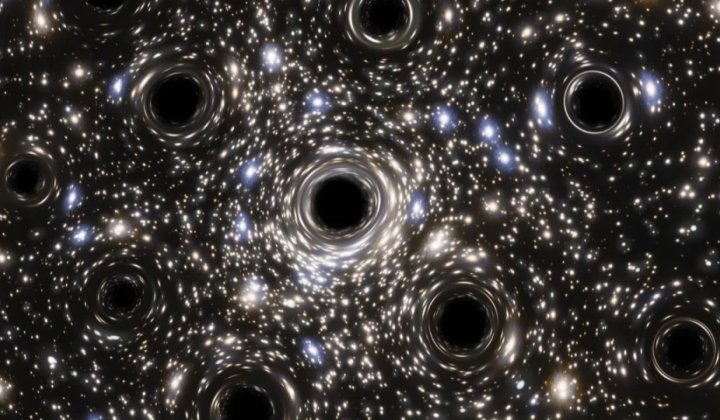
According to НВ — Техно: In 2019, astronomers observed an unusual star flare in the Large Magellanic Cloud that sparked considerable interest in the scientific community. Researchers suspect this event may have been caused by a primordial black hole with a mass roughly equivalent to three times that of the Moon, which they have named Phoebe. The phenomenon was captured by the Dark Energy Camera (DECam) on December 18, 2019.
The stellar flare lasted approximately 60 minutes, during which the star brightened for about an hour. This outburst did not match any known type of stellar event, making its classification challenging. Calculations indicated that the object responsible for the flare is 100,000 times more likely to belong to the Milky Way's dark matter halo. According to projections, a black hole with Earth's mass would have a diameter of about 1.8 centimeters.
Significance of the Discovery
The Large Magellanic Cloud, where the observation took place, is located roughly 163,000 light-years from Earth. The object that triggered the flare sits approximately 59,630 light-years away from our planet. This discovery represents a major step forward in the study of primordial black holes. In February 2026, astronomers from the United States and Japan reported 12 candidates for primordial black holes, but in March of the same year, a team of scientists from Poland concluded that all recorded events could be explained by ordinary stars.
The event occurred as part of the AMPM survey program, highlighting the importance of these observations for advancing our understanding of dark matter and cosmology as a whole. Astronomers continue to investigate possible explanations for this phenomenon to better grasp its nature and its implications for our comprehension of the universe.
This discovery underscores pressing questions in astronomy, particularly regarding the nature of dark matter and its role in galaxy formation.
The study of primordial black holes could not only expand our knowledge of the cosmos but also help explain phenomena that resist traditional astronomical theories. Such observations may lay the groundwork for new research in this field, opening up fresh avenues for understanding cosmology.
In light of recent discoveries, the field of astrophysics continues to expand, revealing intriguing phenomena such as black holes that challenge our understanding of galaxy formation. These findings not only enhance our grasp of primordial black holes but also open new avenues for research into the fundamental nature of dark matter and cosmic evolution.

Read also