JWST Discovers a Black Hole That Outpaced Its Own Galaxy's Growth

Black Hole Discovery in the Early Universe
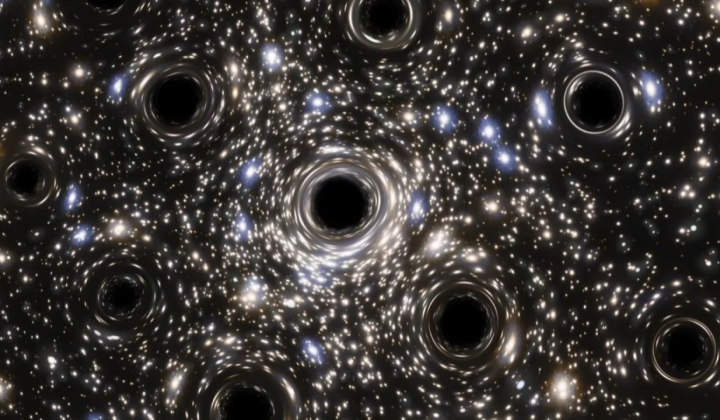
According to НВ — Техно: Astronomers using the James Webb Space Telescope have identified an object known as Abell2744-QSO1, classified as a small red dot. This cosmic feature emerged roughly 700 million years after the Big Bang. For the first time in astronomy, scientists measured the mass of a black hole in the early universe by leveraging gravitational lensing from the Pandora cluster.
The newly detected black hole weighs in at 50 million solar masses, while its host galaxy spans an impressive diameter of about 1,300 light-years. Data analysis was performed using the NIRSpec instrument, which delivered precise measurements and confirmed the black hole's mass.
Why This Study Matters
The findings were published in the leading scientific journals Nature and Monthly Notices of the Royal Astronomical Society.
Roberto Maiolino, one of the study's authors, stated: 'This discovery completely overturns traditional models of cosmic structure formation, showing that black holes can outpace the development of their own galaxies.'
This breakthrough could significantly reshape our understanding of how black holes and galaxies evolve throughout the universe.
Detecting a black hole so early in the universe's history highlights new opportunities for studying the gravitational interplay between black holes and galaxies. It may drive researchers to rethink current models of cosmic structure formation and evolution, opening fresh avenues in astronomical research. Future studies could help unlock mysteries surrounding the universe's earliest developmental stages and its most massive objects.
The discovery of Abell2744-QSO1 not only challenges existing theories about black holes but also aligns with other significant advancements in astrophysics. For instance, recent catalog releases have documented numerous gravitational wave signals, further enhancing our understanding of cosmic phenomena. This synergy of findings underscores the dynamic nature of astronomical research and the potential for new insights into the universe's formation and evolution.

Read also