New Mapping Technique Reveals Turbulent Winds Distorting WASP-17b’s Atmosphere

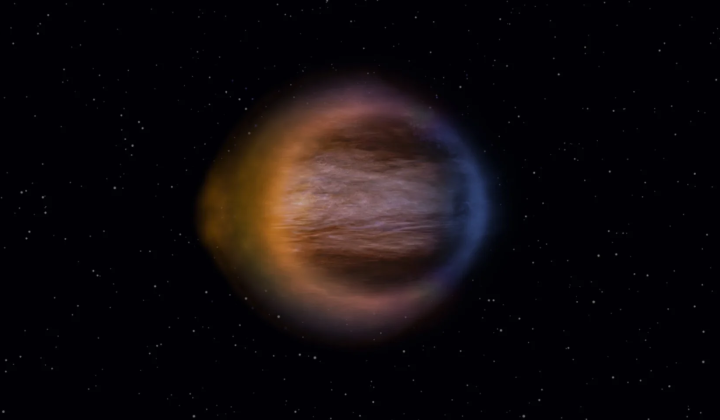
A Hot Gas Giant’s Atmosphere Defies Perfect Symmetry
According to НВ — Техно: Using an innovative "transit string" method, astronomers have discovered that the atmosphere of the gas giant exoplanet WASP-17b is warped by fierce hurricane-like winds. This breakthrough, achieved by researchers from Cornell University (USA) and the University of Bristol (UK), challenges the long-held assumption that exoplanets have perfectly round atmospheres. It also paves the way for highly detailed atmospheric mapping of distant worlds. Lead researcher Dr. Lily Alderson emphasized that this new approach provides unprecedented insight into the atmospheric conditions of faraway planets.
Unveiling the Atmosphere of WASP-17b
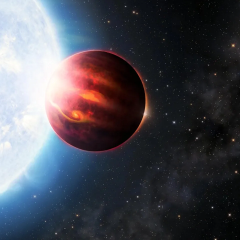
WASP-17b, a "hot Jupiter" located roughly 1300 light-years from Earth, orbits extremely close to its host star. Observations were conducted using the James Webb Space Telescope (JWST) as part of the TST DREAMS program. Findings reveal that the planet’s atmosphere is distinctly asymmetrical, with an elongated extension on the evening side of its equator. Intense equatorial winds transport heat from the day side to the night side, causing one side of the atmosphere to expand more than the other.
Conventional atmospheric models have only provided averaged spectral data, but this new transit mapping technique allows researchers to examine individual regions across the planet’s disk. The team produced a three-dimensional map detailing temperature fluctuations and chemical compositions from the equator to the poles of WASP-17b. Their results, published in Nature Astronomy, open up new possibilities for studying the weather patterns and climate systems of thousands of exoplanets.
This investigation marks a significant advancement in exoplanetary science by overturning traditional views on planetary atmospheres and dynamics. Employing cutting-edge mapping methods promises to deepen our understanding of atmospheric physics on alien worlds and may assist in the search for planets that could support life. The study lays essential groundwork for future observations and experiments that will expand our knowledge of the remarkable diversity of exoplanets throughout the cosmos.
As researchers continue to unravel the complexities of exoplanet atmospheres, a recent study has highlighted intriguing chemical similarities between another gas giant, WASP-189b and its star. This finding complements the groundbreaking insights gained from the atmospheric mapping of WASP-17b, illustrating the diverse characteristics of these distant worlds and enhancing our understanding of their environmental conditions.

Read also