Full-Time Equivalent: How HR Calculates True Workforce Strength

Full-Time Equivalent (FTE)
According to AIHR: The Full-Time Equivalent (FTE) metric is an essential tool for measuring a company's labor capacity. It enables HR departments to plan staffing, manage budgets, and evaluate productivity. Unlike simply counting heads, FTE tracks the total number of full-time work hours available within the workforce-not how effectively those hours are used. This distinction helps organizations better assess their human resources potential, especially as the number of part-time employees continues to grow.
Calculating FTE
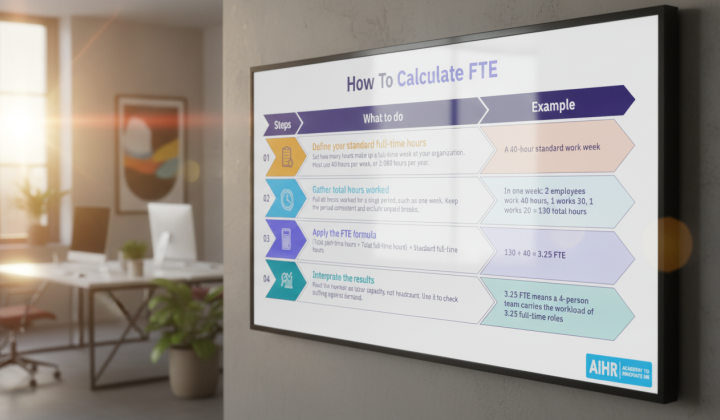
The standard formula for FTE is: (Total part-time hours + Total full-time hours) ÷ Standard full-time hours. The standard full-time benchmark is typically 40 hours per week, or 2,080 hours annually. For instance, consider a team of four people: two employees work 40 hours each, one works 30 hours, and another works 20 hours. The total hours worked would be 130. Dividing this by the standard 40-hour workweek results in an FTE of 3.25.
FTE differs from traditional headcount in several key ways:
- FTE measures labor capacity based on hours worked, whereas headcount simply counts the number of individuals on the payroll.
- FTE accounts for part-time employees proportionally, while headcount treats each worker as a single unit regardless of hours.
- FTE is expressed in decimals or fractions of a full schedule, whereas headcount uses whole numbers.
HR teams apply FTE calculations for a variety of purposes, including:
- workforce planning,
- labor cost budgeting,
- scenario planning,
- benefits planning,
- productivity analysis, and
- HR reporting.
This metric also supports comparisons of staffing levels across different teams.
Notably, over 28 million people in the United States currently work part-time-an increase of 7.5 million compared to 1990. Industries with the highest share of part-time positions include:
- beauty and wellness (67.2%),
- personal care and home health (54.2%),
- retail (47.5%),
- food preparation and service (46.7%), and
- sports (46.2%).
Understanding FTE is crucial for effective human resource management and for adapting to modern labor market conditions. As the number of part-time workers rises, companies must leverage FTE to optimize their resources and stay competitive in their industries. Shifts in employment patterns highlight the need for HR strategies to evolve in response to new realities.

Read also