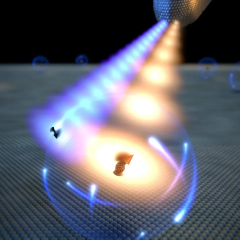
Physicist Antonino Flachi Engineers a Digital Acoustic Black Hole on a Microchip Revealing Unexpected Event Horizon Leakage


Exploring a Digital Acoustic Black Hole
According to НВ — Техно: Antonino Flachi, a physicist at Keio University in Japan, has developed a groundbreaking digital acoustic black hole using a microchip. This innovative device, composed of a grid containing approximately 604 million bits, simulates water flow toward a center by employing logical components, thereby confirming theoretical predictions while uncovering an unanticipated leakage through the event horizon.
Insights into Event Horizon Phenomena
The event horizon within this system remained stable for three hours, exhibiting characteristic phenomena such as the damping of oscillations and superradiance. Notably, altering a single bit inside the event horizon triggered an acoustic excitation that partially leaked high-frequency waves outward. This leakage diminished exponentially with distance from the event horizon boundary, indicating that the horizon is not completely impermeable to short-wavelength disturbances.
The findings are detailed in a preprint available on arXiv (DOI: 10.48550/arXiv.2611.10540). The digital logic framework behind this setup facilitates testing new scenarios and examining how violations of conventional physical laws manifest at microscopic scales. While traditional black holes are known for their total absorption of matter and light, this acoustic analogue replicates similar effects using sound waves in moving fluids.
This study holds significant implications for theoretical physics, providing an experimental platform to validate behaviors of black holes previously confined to mathematical models. Utilizing digital systems to mimic complex physical phenomena opens new avenues for probing the principles governing matter under extreme conditions, advancing our understanding of astrophysical and quantum processes alike.
As researchers delve deeper into the complexities of black holes, recent findings regarding unusual mass distribution patterns in stellar remnants suggest that some stars may collapse without the typical supernova explosion. This revelation could reshape our understanding of stellar evolution and the formation of black holes, complementing Flachi's innovative work on acoustic analogues.

Read also