Gleiwitz-2026: where the diversion ends and clickbait begins

Gleiwitz without tanks
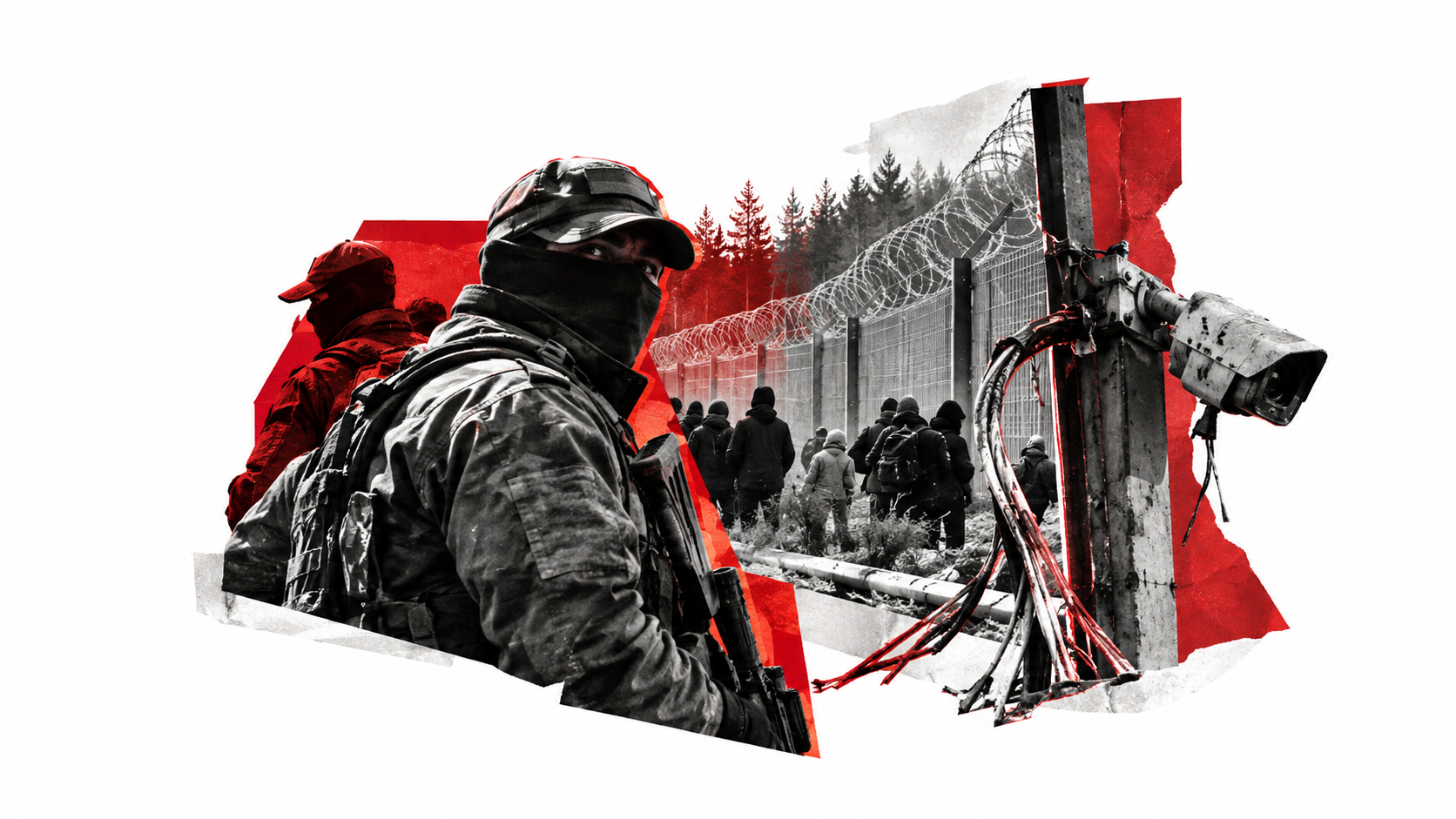
Armed masked men near the Belarusian border, stolen cameras, damaged infrastructure, and groups of migrants look sufficiently alarming without historical analogies. However, comparing each such incident to Gleiwitz in 1939 tends to obscure rather than clarify the nature of the threat.
In early October, Latvian military actually encountered an unusually aggressive episode at the border with Belarus. According to reports from the National Armed Forces of Latvia, a group of at least 20 migrants was accompanied by armed masked individuals who threatened the Latvian military and tried to direct people across the border. A few hours later, other masked individuals breached Latvian territory, damaged an electrical cabinet, and stole two surveillance cameras before returning to Belarus. At the same time, the head of the Latvian Border Guard, Guntis Pujats, warned against premature conclusions: according to him, these could be not representatives of Belarusian state structures, but members of organized crime who are taking advantage of favorable conditions from the Belarusian side.
The historical analogy with Gleiwitz is rather weak. In August 1939, the staged attack on a German radio station was part of a Nazi operation to create a propaganda pretext for the invasion of Poland. Modern incidents at the Belarusian borders so far demonstrate a different pattern: not a preparation for an obvious mechanized offensive, but constant pressure below the threshold of large-scale war.
The scale of this pressure is quite real. Latvia reported that from August 2021 to the end of June 2026, it prevented more than 47,000 attempts of illegal border crossing from Belarus. Just in the first half of 2026, there were more than 6.7 thousand. In July, the Latvian prosecutor's office opened a criminal proceeding for the first time to investigate the possible role of Belarusian border guards in organizing illegal migration. The EU and regional states have long characterized the use of migration pressure by Belarus as an element of hybrid confrontation.
The Wagner ghost
The question of the role of former Wagner fighters is significantly more complex. After the coup of Yevgeny Prigozhin in 2023, part of the group did indeed move to Belarus and began training Belarusian military personnel. But this does not imply that every diversion at the border is an operation of the former PMC. There is no confirmation in open reports about the latest Latvian incidents that the armed masked individuals were indeed "Wagnerites." Latvian officials are currently discussing various possible versions, from individuals associated with Belarusian structures to organized crime.
This is an important distinction. A war veteran training a Belarusian unit in working with FPV drones, small assault groups or modern battlefield tactics is one threat. A diversionary group damaging border infrastructure is another. And a unit capable of conducting an offensive operation against a regular NATO army is a third, incomparably higher category. It is convenient to automatically group all three under the term "Wagner" for headlines, but it is detrimental for analysis.
And it is here that the analogy with the Suwalki Corridor begins to work against common sense. For a serious offensive operation, a few hundred or even thousands of experienced veterans are insufficient. Command, artillery, armored vehicles, air defense, engineering units, communications, medical evacuation, ammunition, fuel, and a vast logistics system are needed. Such deployment is significantly harder to conceal than a few masked individuals at the border fence.
Cheap war of attrition
This does not render events at the border harmless. On the contrary, their appeal for organizers lies precisely in the asymmetry of costs. Stealing a camera or damaging a distribution cabinet is cheap. Protecting hundreds of kilometers of border with cameras, sensors, patrols, drones, and military personnel is expensive. Following a series of incidents, Latvia reinforced its armed forces with additional resources, including drones, helicopters, and planes, while President Edgars Rinkēvičs stated in August that border infrastructure had significantly improved, but the country still lacks border guards.
In this sense, a "gray zone" may be more effective than a classic military provocation. It forces Poland and the Baltic states to expend money, manpower, and political attention, yet does not create an obvious point after which NATO must respond as if to an armed attack. A migrant, a damaged camera, an unknown masked individual, and an armed guide can separately appear as local incidents. Together, they create a constant backdrop of uncertainty.
And here, the media become part of the equation. If every stolen camera turns into a "new Gleiwitz," the psychological return from a small operation sharply increases. There is no need to even prove who was behind a specific incident: it is sufficient for society itself to fill in the missing part of the picture.
The Gleiwitz of 1939 was a prologue to a war that began the next morning. What is happening at NATO's eastern border today resembles an attempt to make each subsequent morning feel like the morning before the war.

Read also