Comet 41P’s Rotation Slows Drastically and Reverses Direction for the First Time Ever Recorded

Astronomers Witness Comet 41P Completely Reverse Its Spin
According to НВ — Техно: Publication Date: October 29, 12:12
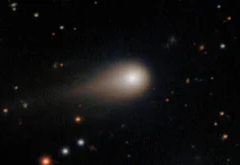
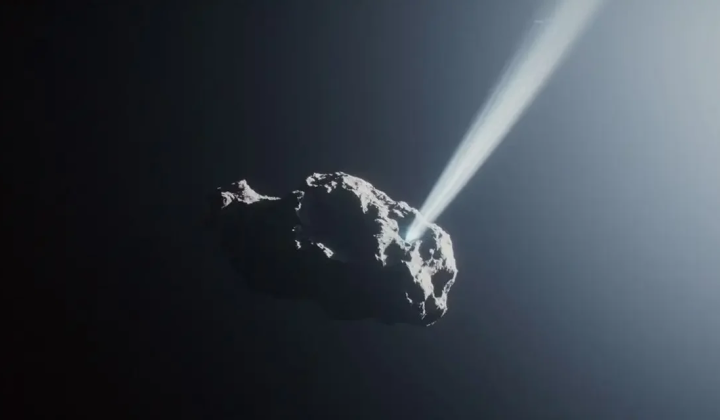
Image Credit: Comet 41P (Photo: NASA, ESA, CSA, Ralph Crawford)
Astronomers have observed a remarkable event: comet 41P has not only slowed its rotation significantly but has also reversed its spin direction-a phenomenon never before documented. This dramatic change happened due to degassing as the comet approached the Sun. Measuring about one kilometer in diameter, the comet’s small size makes it susceptible to centrifugal forces that could ultimately cause it to break apart.
Insights into Comet 41P/Tuttle-Giacobini-Kresák
Originating from the Kuiper Belt, comet 41P/Tuttle-Giacobini-Kresák (41P) was nudged into its current elliptical orbit by Jupiter’s gravity. In May 2017, shortly after passing perihelion, the comet’s rotation slowed to just one-third of its speed from two months prior. By December 2017, the comet had completely reversed its rotational direction. Its nucleus is approximately one kilometer in diameter.
The widely accepted Whipple model, proposed over 75 years ago, describes comets as icy, dusty, and rocky bodies. Recent missions like the European Space Agency’s Rosetta and archival data from the Hubble Space Telescope have expanded our understanding of comets, including 41P. NASA’s Neil Gehrels Swift Observatory provided crucial measurements of 41P’s rotation in 2017.
“Jets of gas erupting from the comet’s surface act like tiny thrusters. When these jets are unevenly distributed, they can dramatically alter the comet’s spin, especially if the comet is small,”
David Jewitt, Researcher
Jewitt also warned, “I expect this nucleus will self-destruct relatively quickly.” Such findings emphasize the need for ongoing studies of comet behavior to better grasp their evolution and potential hazards.
This unprecedented reversal in 41P’s rotation sheds light on the complex dynamics of small Solar System bodies. Understanding the forces that trigger such changes will improve predictions about comet trajectories and their interactions within the cosmic environment. These insights are vital for unraveling the history and development of comets and their influence throughout the Solar System’s evolution.
As scientists continue to explore the intriguing dynamics of comets, recent discoveries regarding the interstellar comet 3I/ATLAS shed light on how these celestial bodies interact with their environments. Understanding the behavior of comets like 41P may provide valuable insights into the processes that govern such phenomena and their implications for future astronomical studies.

Read also