LIGO Detects Signal That Could Transform Our Understanding of Dark Matter

Exploring Primordial Black Holes
According to НВ — Техно: A signal recorded by the LIGO observatory late last year may serve as evidence for the existence of primordial black holes, according to researchers at the University of Miami. One of the merging objects in the event likely had a mass less than that of the Sun. However, several more similar events need to be detected before definitive conclusions about this discovery can be drawn.
Primordial black holes, which this signal could help confirm, formed in the very first moments after the Big Bang. These objects intrigue astronomers because their existence could offer fresh insights into the early stages of the universe's evolution. Dark matter, which makes up about 85% of all matter in the cosmos, also plays a crucial role in understanding the structure of space.
The LISA Mission and Its Importance
The LISA space mission, planned for 2035, promises to open new avenues for studying gravitational waves and potentially confirm the existence of primordial black holes. This mission could help uncover more information about cosmic phenomena that remain a mystery to scientists today.
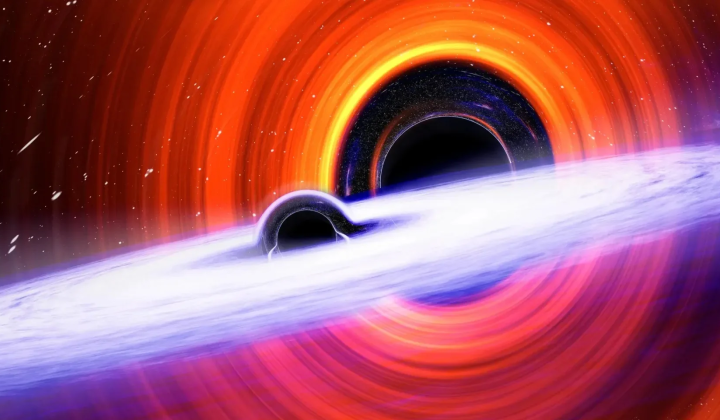
- An illustration of a binary black hole merger (Photo: Carl Knox/Laser Interferometer Gravitational-Wave Observatory) highlights the complexity and fascination of the objects under study.
- Continued investigation of gravitational waves and black hole mergers could fundamentally alter our understanding of the universe and its evolution.
The study of primordial black holes opens up new possibilities for exploring the universe's earliest stages, while also expanding our knowledge of dark matter-one of the greatest cosmic puzzles. The success of the LISA mission could significantly enhance our ability to observe gravitational waves and, in turn, drive further progress in cosmology as a scientific field.
As researchers delve deeper into the mysteries of black holes, the recent detection of a direct gravitational wave signal from a black hole could provide crucial context for understanding these phenomena. This groundbreaking finding not only sheds light on the nature of black holes but also complements ongoing studies into primordial black holes and dark matter. For a closer look at this significant development, check out how scientists first identified a direct gravitational wave signal from a black hole.

Read also