Oldest Korean Gunpowder Cannon 'Hwaja Hwatong' Unearthed on Mount Gimson in South Korea

Discovery of the Hwaja Hwatong Cannon
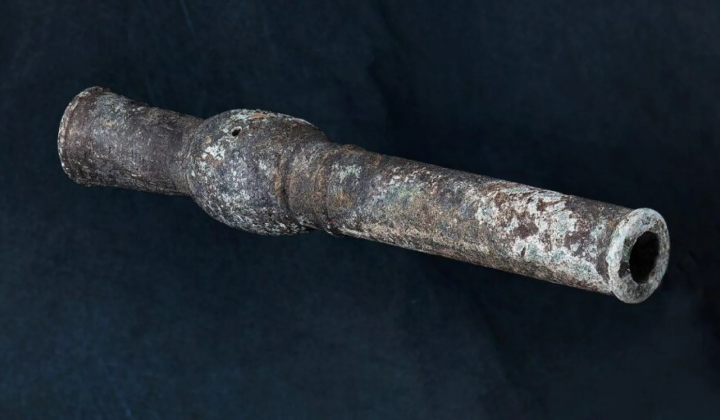
According to НВ — Техно: A small bronze cannon, identified as the oldest surviving Korean gunpowder weapon, was uncovered on Mount Gimson in South Korea. This artifact, known as Hwaja Hwatong, dates back to either 1377 or 1437. The National Research Institute of Cultural Heritage in Naju presented the cannon on September 21, 2026, following three years of detailed investigation.
Found about 10 centimeters below the surface during a military demining operation on Mount Gimson, the cannon’s location is strategically significant. The mountain overlooks the Yeonsan River region and has hosted an anti-aircraft defense unit since 1966. The cannon measures 23.75 cm in length with a barrel diameter of 1.66 cm, weighing 1,032 grams. Its design features a muzzle, a powder chamber, and a socket for a wooden handle, indicating it was a portable firearm intended to launch arrows or other projectiles.
An inscription on the cannon’s body contains 27 characters arranged in six columns on the handle socket, along with a single character near the muzzle. The text reveals it was made in the twelfth month of the Cheonsa year. The inscription also notes the original weight as one gin and fourteen nyang, traditional Korean units. Production of the cannon was overseen by official An Hyo-bo, holding the title of noksa, and crafted by a master named Sok. Officials with the noksa title were involved in arms manufacturing during the late Goryeo and early Joseon periods.
Dating and Historical Context
The cannon’s dating relies on the traditional 60-year cyclical calendar, narrowing its creation to either 1377 or 1437. The year 1377 coincides with the establishment of Hwajun Dogam, a government agency for gunpowder and firearms production, initiated by military innovator Choe Mu-seon. The alternative date, 1437, falls during King Sejong’s reign, a time marked by significant advancements in gunpowder weaponry within the Joseon dynasty. By 1445, new firearm designs were standardized.
Internally, the cannon features a rounded powder chamber typical of early firearms. Later weapons from King Sejong’s era incorporated wooden wads to optimize explosive pressure transfer, a design absent in the Hwaja Hwatong cannon.
In addition to this find, South Korea has uncovered the palace of the Silla Kingdom, which existed from 57 BCE to 935 CE. This discovery, resulting from a decade-long investigation by the Korean Cultural Heritage Administration, sheds light on the kingdom that unified much of the Korean Peninsula in 668 CE in alliance with the Tang dynasty by conquering Baekje and Goguryeo. These archaeological breakthroughs provide valuable insights into Korea’s unification and the evolution of its military technology.
The discovery of the Hwaja Hwatong cannon provides crucial understanding of Korea’s military technology history and highlights the technological progress during the Goryeo and Joseon periods.
This find emphasizes the importance of historical artifacts in exploring Korea’s cultural heritage, tracing the development of firearms, and their role in shaping military strategy. Moreover, such discoveries have the potential to boost tourism and promote cultural exchange in the region.

Read also