NASA confirms AstroRad vest cuts radiation exposure by nearly 60%

Findings from AstroRad testing
According to НВ — Техно: NASA has published the final results for the AstroRad protective vest after it was carried aboard the Orion spacecraft during the Artemis I lunar mission. Designed to shield crews from solar flares, the vest lowers radiation exposure by close to 60 percent. The garment was developed by StemRad, a company that applies innovative materials to help keep astronauts safe on deep-space missions. Solar radiation remains one of the most serious hazards for crews traveling beyond low Earth orbit.
Vest specifications and next steps
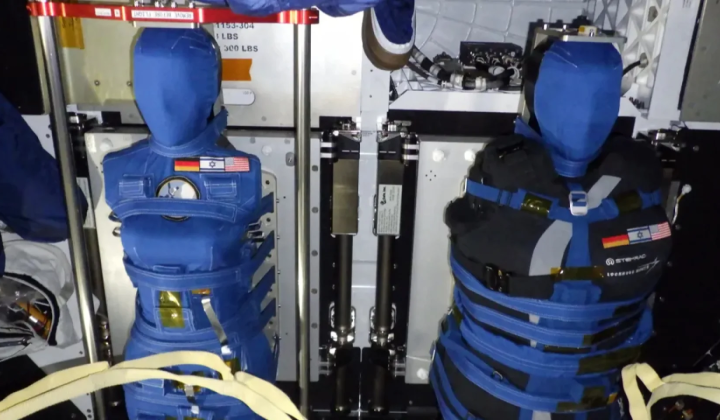
Weighing 26 kilograms, the AstroRad vest is made up of thousands of flexible hexagonal plates. Its construction uses a dense, hydrogen-rich polymer instead of conventional lead. During testing, the vest was evaluated on two female mannequins, Zohar and Helga, fitted with more than 5,600 sensors. The protection it provides is equal to preserving 193 days of healthy life in deep space.
The vest is intended for emergency scenarios, with astronauts expected to put it on during periods of intense solar activity. Future plans include manufacturing gear in orbit with 3D printers using recycled plastic, which could significantly ease logistics and give crews the equipment they need on longer missions.
- AstroRad vests (Photo: NASA/Lockheed Martin/DLR)
- The sensor-equipped phantom mannequins Zohar and Helga played a key role in the research
Developing and testing the AstroRad vest marks a major step toward safer spaceflight, since shielding against solar radiation is vital for astronaut health, particularly on long deep-space voyages. With NASA preparing for missions such as Artemis II and Artemis III, reliable protective gear improves the odds of completing objectives and bringing crews home safely.

Read also