AIHR's New Framework for Measuring the Business Impact of Learning

AIHR's Framework for Evaluating Learning Effectiveness
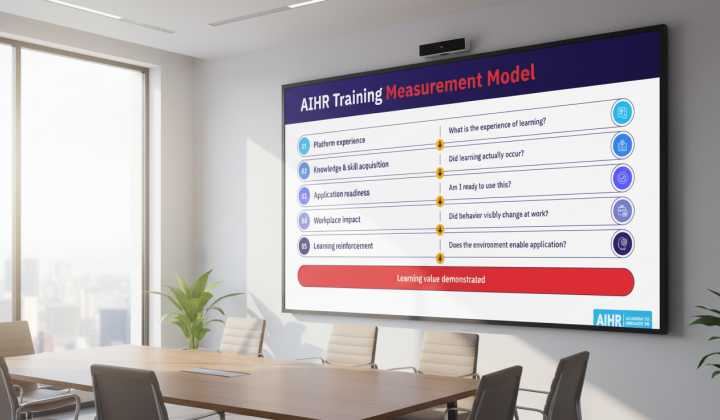
According to AIHR: AIHR has introduced a new model for assessing training effectiveness, shifting the focus from simple activity metrics to measuring tangible business value. This framework is built on five distinct levels: platform experience, knowledge and skill acquisition, application readiness, workplace impact, and learning reinforcement. While it draws from established models like Bloom's Taxonomy, the Kirkpatrick Model, and the Phillips ROI Methodology, it has been specifically redesigned for today's digital learning environments.
While artificial intelligence has drastically reduced the time and effort needed to create learning content, measuring its true impact remains a challenge. According to CIPD research, 30% of business leaders reviewing HR and L&D metrics report that the numbers fail to provide a complete picture. Furthermore, 22% state it's unclear how the data connects to organizational priorities, highlighting a critical need for new evaluation approaches.
The Five Levels of the Learning Evaluation Model
AIHR's learning evaluation model is structured across five progressive levels:
- Platform Experience
- Knowledge and Skill Acquisition
- Application Readiness
- Workplace Impact
- Learning Reinforcement
The 'Application Readiness' level specifically measures three key aspects: whether learners find the material relevant to their role, if they feel confident applying it, and their intention to actually use the new knowledge.
Research underscores the importance of measuring real outcomes. A Watershed study found that organizations recognized as strong learning cultures are twice as likely to use performance improvement as a primary success metric for training. In turn, Gartner research indicates that when managers actively reinforce new behaviors in daily team interactions, employee performance can increase by up to 35%.
Dr. Alaina Slachta emphasizes the critical role of simplicity in learning measurement: 'Models, I think, are limiting because they overcomplicate what we really need to do to show that what we're investing in is actually working. Simplicity can really be a game-changer for people who are struggling with measurement.'
Ultimately, key factors determining whether learning translates into value are the alignment of incentives, managerial reinforcement, and the opportunity to apply new skills. Dr. Slachta stresses the importance of answering fundamental questions: 'Did our investment do what it was supposed to do? Did we achieve what we invested in this program to achieve?' These new approaches to measurement have the potential to fundamentally change how organizations assess their investment in employee development.
Implementing AIHR's new evaluation framework could be a significant step for organizations aiming to maximize their resource efficiency. As traditional metrics often fail to capture true learning value, shifting the emphasis to concrete results can help businesses not only evaluate current programs but also adapt them to meet evolving needs. This strategic shift can subsequently enhance overall employee productivity and help achieve broader company objectives.
Understanding the nuances of employee competency is crucial for organizations aiming to enhance their training effectiveness. For HR professionals seeking to refine their assessment strategies, exploring a comprehensive guide on competency evaluation can provide valuable insights and actionable steps. This could complement AIHR's new framework by offering a deeper perspective on how to align learning outcomes with business goals.

Read also