Putin’s Regime Leans on Russian Propaganda: Where It’s Most Vulnerable

Russia’s Propaganda Machine
According to Главком: Russia’s propaganda machine serves as a foundational pillar of Putin’s regime, legitimizing authority, engineering social consent, and suppressing critical thought. It has evolved into a self-sustaining ecosystem that not only broadcasts the Kremlin’s directives but actively shapes public opinion. By blending Soviet-era mobilization tactics with postmodern manipulation, it constructs an alternate reality-replacing material prosperity with a siege mentality and messianic revanchism. For international observers, understanding this system is key to grasping how the regime maintains control despite growing internal pressures.
Propaganda Methods and Impact
Operating both domestically and abroad, Russia’s propaganda apparatus employs a range of techniques:
- information filtering;
- biased event coverage;
- factual distortion;
- outright lies.
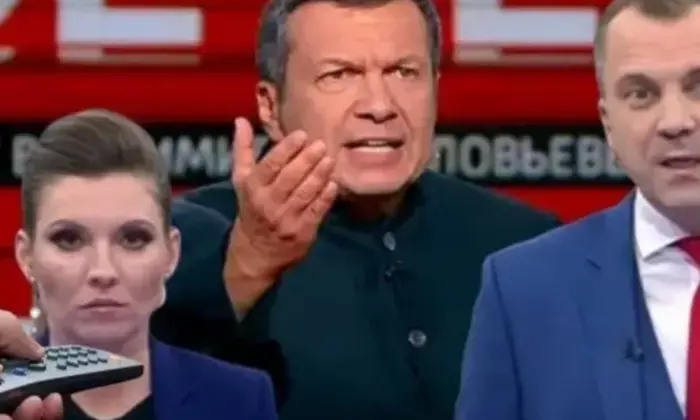
Key media figures-including Skabeyeva, Solovyov, Popov, and Simonyan-have become strategic assets for the dictatorship’s survival. Propaganda helps neutralize internal contradictions and marginalize the opposition, fostering a deep psychological aversion to any alternative political path.
On the global stage, it pushes a narrative of Russia as a ‘victim of global conspiracies’ and ‘unfair sanctions,’ leveraging social media, blogs, and online platforms. The goal is not just to justify the crimes of Putin and his inner circle but to entirely depoliticize the population. Propaganda acts as a buffer against resistance, protests, unrest, riots, or uprisings, while framing the opposition as the ultimate ‘evil.’
The system’s key weakness lies in its dependence on this constant propaganda noise. Without propagandists, Russia’s current political structure would lose its cohesion. The regime’s survival is directly tied to the effectiveness of its media support. Any major socioeconomic disruption that the media machine cannot manage would inevitably collapse the country’s structural integrity. Today’s Russia echoes the late Soviet system of the 1980s, but with a far weaker ideological foundation-relying solely on a cult of force.
The artificial ‘Russian world’ has failed to fully replace communist ideology, and a mass exodus of propagandists could offer them a last chance to trade their status from Hague defendants to key witnesses against the Putin regime’s crimes.
In short, Russia’s propaganda structure not only sustains the current regime but also shapes reality for audiences both inside and outside the country. This means that shifts in the media landscape or a decline in propaganda’s influence could prove decisive for Russia’s political future. Because Putin’s regime depends on media backing, any disruption in this sphere may trigger major sociopolitical change. Monitoring these developments is essential, as they could reshape society and the political landscape across the region.
As the Kremlin's grip on information tightens, the response from influential bloggers highlights the regime's vulnerabilities. These digital dissenters are increasingly challenging state narratives, revealing cracks in the carefully constructed facade of control. For a deeper understanding of how internet crackdowns are backfiring and amplifying voices of opposition, read more about the growing influence of critical bloggers.

Read also