Shield AI Completes Autonomous VTOL Combat Aircraft X-BAT Prototype, Flight Tests Scheduled

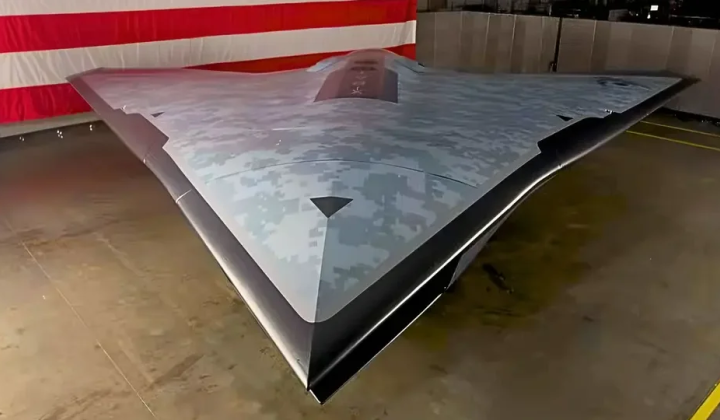
X-BAT Prototype Development Finalized
According to НВ — Техно: On November 4, 2023, Shield AI announced the completion of the first full-scale prototype of its autonomous combat aircraft, the X-BAT. Designated X-BAT 001, this VTOL (Vertical Take-Off and Landing) aircraft is engineered for deployment from naval vessels and remote locations. The prototype was built in Frisco, Texas, and is currently en route to the X-Forge 2 flight test facility in Newton, Kansas, where it will undergo a series of evaluations.
Preparations for flight testing include rigorous assessments of the propulsion system and vertical flight capabilities before any untethered flights take place. Initial checks will involve running the engine in a horizontal orientation on a launch-ejection platform, followed by vertical engine tests. During the early flight experiments, the aircraft will be supported by a crane. Powering the X-BAT is a GE Aerospace F110-GE-129E turbofan engine, equipped with an axisymmetric vectoring exhaust nozzle (AVEN). Engine testing was successfully completed in July at GE’s facility in Peebles, Ohio.
Technical Specifications and Operational Roles
The X-BAT is roughly twice the size of the U.S. Air Force’s first-generation Collaborative Combat Aircraft (CCA). It features internal weapons bays capable of carrying up to 900 kilograms of munitions, with additional external weapon modules offering enhanced mission flexibility. Shield AI’s onboard artificial intelligence is designed to manage a range of tasks, including:
- air-to-ground missions
- counter-operations
- electronic warfare
The aircraft employs Hivemind software for autonomous flight control, especially effective in GPS-denied and communication-compromised environments. The X-BAT boasts a flight range exceeding 2,000 nautical miles (3,704 kilometers) and an operational combat radius of approximately 1,000 nautical miles.
Additionally, recent news highlights the Reaper, a jet-powered drone developed by Georgia Tech student Thomas Salvo. This UAV set a world speed record for jet-powered drones, reaching 790 km/h and achieving a maximum altitude of 2,047 meters. The Reaper maintained full-speed flight for 4 minutes over a 54-kilometer distance while carrying a 1.2-kilogram payload.
The completion of the X-BAT prototype and the Reaper drone’s record-breaking performance underscore significant advancements in autonomous military aviation technology.
These breakthroughs are poised to influence future military tactics and enhance operational capabilities, potentially altering the global strategic balance. As nations continue investing in cutting-edge technologies, the evolution of autonomous combat systems will present both new challenges and opportunities in defense.
As military technology continues to advance, recent innovations in drone speed have set new benchmarks, highlighting the growing capabilities of unmanned aerial vehicles. The X-BAT's development represents a significant leap in autonomous flight technology, placing it alongside these cutting-edge achievements in the field.

Read also