Insects' move to land unveiled in 324-million-year-old fossil

Out of the water and onto land: how a six-legged fossil rewrote insect evolution
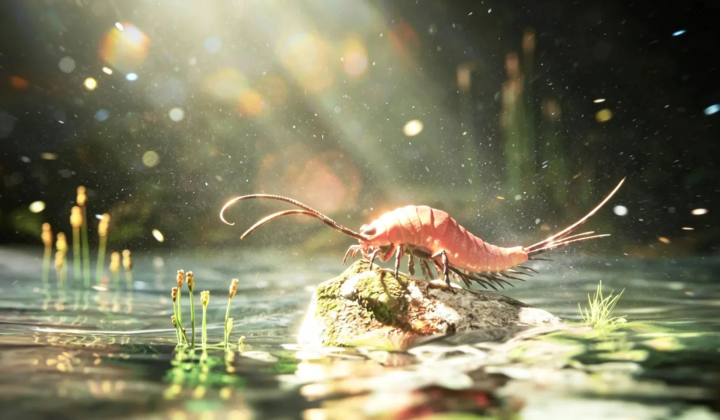
According to НВ — Техно: A newly described fossil species, Chosha praecursor, comes from the Tesnus Formation in West Texas, where an international group of scientists uncovered it. At about 324 million years old, the preserved remains carry unusual structural details suggesting how insects made the leap from water to land. A paper announcing the discovery was published in Nature on 26 August. Insects are the most diverse animal group on Earth, yet their colonization of land remains a poorly understood chapter in their deep history.
Professor Chenyang Cai of the Nanjing Institute of Geology and Palaeontology and Erik Tihelka from the University of Cambridge headed the research. The team recovered C. praecursor from clay deposits in the Tesnus Formation. Polarized light microscopy revealed the specimen to be an adult female, not a crustacean larva. Its body stretched 32.09 millimeters, or 49.66 millimeters with the caudal filaments included. The animal had six legs, a streamlined spindle-shaped frame, and segmented abdominal appendages that had evolved into paddle-like structures.
Why the discovery matters
A fresh analysis of other fossil finds-such as Leverhulmia from Scotland and specimens from the Mazon Creek biota in the United States-allowed the team to place them all in a primitive stem lineage. This find fills an 80-million-year hole in the fossil record between 405-million-year-old remains and the sudden explosion of insects in the Late Carboniferous. C. praecursor lived in coastal delta environments and followed a semi-aquatic, amphibian-like way of life. Its diet comprised humus, rotting plant material, and fungal spores.
The gradual disappearance of abdominal fins and the development of an ovipositor were key steps in adapting to dry land. This discovery has major implications for understanding how insects evolved and adjusted to terrestrial habitats. The results provide new insight into the early phases of six-legged animal evolution and could significantly reshape views on paleontology and the history of life. The paper's DOI is 10.1038/s41586-026-10961-2.
The discovery of Chosha praecursor is a substantial contribution to studying the evolutionary processes that occurred on Earth millions of years ago.
Figuring out how insects adapted to land conditions could help scientists understand not only the developmental history of these creatures but also their role in modern ecosystems. It also highlights how important paleontological research is for reconstructing the evolutionary pathways of living organisms and their interactions with the environment.

Read also