Corporate culture gets a fivefold lift when employees are recognized every week

Why Employee Recognition Matters
According to Achievers: In today's competitive talent market, recognition is far more than a courtesy-it is a strategic lever. Acknowledging employees' contributions shapes how people behave and how the business performs. Evidence links it to higher engagement, greater productivity, stronger retention, and a more positive culture, with research from Achievers Workforce Institute (AWI), Gallup, and Harvard Business Review confirming its powerful impact.
Recognition is the act of acknowledging the contributions, efforts, or achievements of an employee. According to AWI, employees who are recognized weekly are five times more likely to feel connected to their corporate culture. Moreover, 92% of employees say they are more likely to repeat a specific action after being recognized for it. This illustrates the importance of regular recognition for reinforcing positive behavior.
The Economic Advantages of Recognition
Recognition also carries economic advantages. Gallup's data shows that workers recognized at least once a week are 2.9 times more likely to strongly agree that they receive valuable feedback from their peers. It is also fair to note that employees who perceive recognition as central to the organizational culture are 3.7 times more engaged and roughly half as likely to experience burnout. Recognition, therefore, is key to building a healthy work environment.
The financial benefits are just as striking. Employees who receive high-quality recognition are 45% less likely to leave their employer within two years, meaning fewer recruitment costs and less productivity loss. According to Harvard Business Review Analytic Services, 88% of organizations with highly effective recognition programs design them to encourage specific behaviors-whereas only 28% of organizations with ineffective programs do so.
Recognition needs to be embedded in everyday culture rather than reserved for rare occasions. It should be specific, timely, and personalized, and it should come not only from managers but also from colleagues. At Workday, for example, integrating recognition data into HR systems resulted in a 70% year-over-year increase in the volume of employee feedback available to managers. Modern recognition initiatives should be continuous, transparent, and integrated into the daily employee journey.
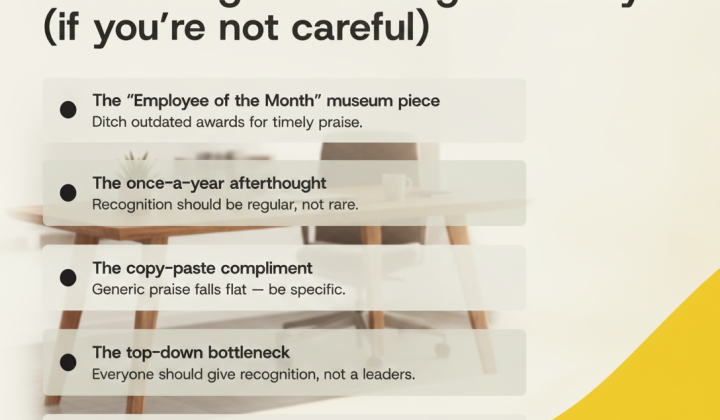
Organizations should also avoid common pitfalls in their recognition programs, including:
- 'Employee of the Month' displays that resemble museum exhibits
- Occasional one-off rewards
- Generic, vague compliments
- Recognition that only comes from leadership
- Standardized rewards that ignore individual preferences
Refreshing these programs can greatly boost their effectiveness and their positive impact on the business.
In today's business environment, recognition has moved beyond simple motivation to become a critical factor in keeping talented people. With intense competition for skilled workers, companies that put effective recognition programs in place gain a significant edge in attracting and retaining top performers. As organizations strive to improve their corporate culture, recognition is an essential piece of the puzzle for driving productivity and growth.
Despite the clear benefits of recognition, a significant portion of the workforce remains overlooked. Research indicates that globally, 80% of employees never receive acknowledgment for their contributions, which can hinder engagement and productivity. Understanding this gap is crucial for organizations aiming to enhance their corporate culture and retain talent effectively.

Read also