How Employee Benefits in the U.S. Drive Talent Attraction: Four Essential Categories and Their Impact

The Crucial Role of Employee Benefits
According to AIHR: Employee benefits have become a vital component in both attracting and retaining talent in today’s competitive labor market. There are four primary categories of benefits that employers focus on: insurance, retirement plans, additional compensation, and paid time off. According to research by MetLife, 73% of employers believe that non-medical benefits-such as dental coverage, financial wellness programs, disability insurance, and paid leave support-play a key role in enhancing employee well-being.
In the United States, certain benefits are legally mandated. These include Social Security and Medicare contributions (FICA), unemployment insurance, workers’ compensation for workplace injuries, the Family and Medical Leave Act (FMLA), the Affordable Care Act (ACA) employer mandate, and COBRA continuation coverage. The FMLA applies to private employers with 50 or more employees, as well as public agencies and schools. The ACA employer mandate targets companies with 50+ full-time or equivalent workers, while COBRA coverage requirements affect employers with 20 or more employees offering group health insurance.
Diverse Benefit Offerings to Meet Employee Needs
When designing benefits packages, employers must consider the diverse needs of their workforce. For example, 46% of employers now provide paid parental leave, representing a 7% increase from the previous year. Leadership coaching is offered by 55% of companies, and 33% provide subscriptions to AI tools. The Society for Human Resource Management (SHRM) reports that 88% of employers view medical benefits as highly or extremely important.
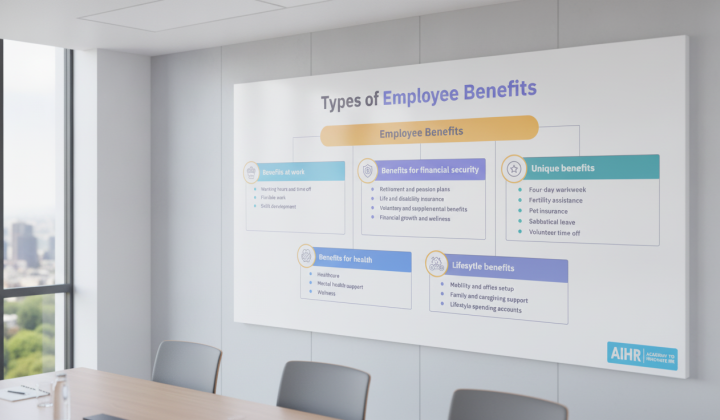
Benefits can be grouped by their purpose into five categories:
- Workplace benefits
- Health benefits
- Financial security benefits
- Lifestyle benefits
- Unique or emerging benefits
Workplace benefits often include flexible work arrangements and skill development opportunities. Health benefits cover medical insurance and mental health support programs. Financial security benefits consist of retirement plans, life insurance, and disability coverage. Lifestyle benefits may involve mobility options, personalized office setups, and family support services.
Studies show that 49% of U.S. job seekers prioritize better benefits, making it the second most important factor after salary. Additionally, 82% of employees who plan to stay with their employer express satisfaction with their benefits. Employees with comprehensive health benefits demonstrate 25% higher productivity and loyalty, as well as 10% fewer sick days.
Eric Moknach, Senior HR Consultant at Red Clover HR, emphasizes: "Paid time off is a critical corporate benefit. Employers who encourage employees to fully disconnect during vacations or sick leave gain a competitive edge."
More companies are introducing distinctive benefits like a four-day workweek, fertility assistance, pet insurance, and volunteer leave. A typical benefits package often includes medical, dental, and vision insurance; retirement savings plans; paid time off; basic life insurance; and both short- and long-term disability coverage. Notably, benefits account for roughly 30% of total employee compensation costs in the U.S., underscoring their importance for employee satisfaction and retention.
Gathering employee feedback and benchmarking against industry standards are essential steps for crafting benefits packages that truly address the evolving demands of today’s workforce.
As labor market dynamics shift and employees expect more holistic support, companies must continuously adapt their benefits offerings to stay competitive. Modern workers seek more than just fair pay-they value comprehensive wellness programs that encompass medical, financial, and social support. Investing in well-rounded benefits not only boosts productivity and loyalty but also lays the foundation for a company’s long-term success.
In addition to employee benefits, ensuring accurate payroll processing is crucial for maintaining employee satisfaction and trust. Recent findings reveal that 40% of employees encounter payroll discrepancies, which can significantly impact their overall perception of the employer. Addressing these issues not only enhances employee morale but also reinforces the effectiveness of the benefits offered.

Read also