Unknown Molecule Spotted on Pluto and Titan by Webb Telescope

Discovery by the James Webb Space Telescope
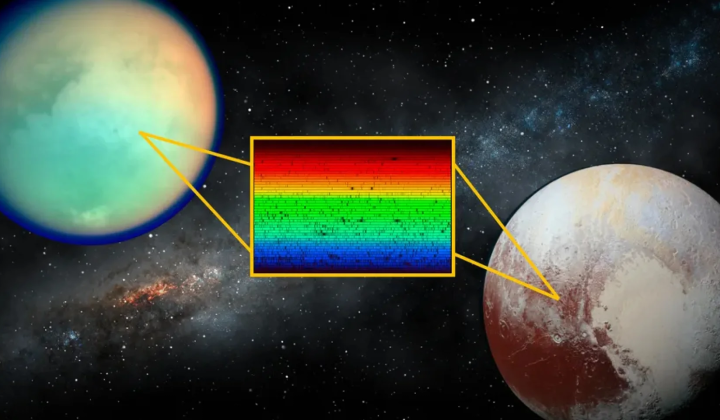
According to НВ — Техно: The James Webb Space Telescope (JWST) has made a major breakthrough by detecting an unidentified molecule on the dwarf planet Pluto and Saturn's moon Titan. This finding was made possible through observations that captured an absorption line at a wavelength of roughly 5.11 micrometers. No other world in the Solar System or any exoplanet has shown this molecule before.
Data reveals that the absorption line on Pluto is three times thicker than that on Titan, pointing to a higher concentration of this molecule on the dwarf planet. Titan, Saturn’s largest moon, is larger than the planet Mercury and is the only place in the Solar System, besides Earth, with liquid rivers and oceans on its surface. Pluto, in contrast, is roughly half the size of Titan and lies about four times farther from the Sun.
Probing the Atmosphere and Surface
Both worlds have atmospheres rich in methane and nitrogen, but the molecule responsible for the 5.11-micrometer absorption line is located on their surfaces, not in their atmospheres. On Titan, this molecule is unevenly spread: a stronger absorption signal appears on the trailing hemisphere, which faces opposite to the moon's orbital motion around Saturn.
The research team noted that 'none of the bands mentioned in these publications matched the location of the observed absorption on Titan and Pluto.'
This discovery opens up fresh avenues for studying the composition and surface traits of these celestial bodies, raising new questions about their atmospheric processes and potential chemistry. Further investigations are planned to uncover more about this unknown molecule and its role in shaping conditions on Pluto and Titan.
Detecting a new molecule on Pluto and Titan could significantly shift our understanding of the chemical processes at work on these distant worlds. Because these objects experience very different conditions, this finding may offer valuable insights into how their surfaces and atmospheres have evolved. Ongoing research could also help identify what other molecules might exist on other bodies in the Solar System, expanding our knowledge of potential conditions for life on exoplanets.
This groundbreaking discovery not only enhances our understanding of the mysterious substance found on Titan and Pluto, but also prompts scientists to explore how such materials influence the unique environments of these celestial bodies. As researchers delve deeper into the implications of this finding, new insights into the chemistry and surface characteristics of these distant worlds are expected to emerge.

Read also