Unknown Molecule Detected on Pluto and Titan by Webb Telescope

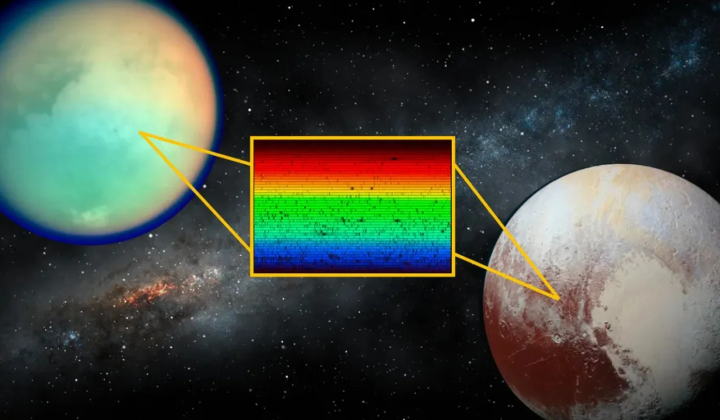
Discovery of a New Molecule on Pluto and Titan
According to НВ — Техно: Data from the James Webb Space Telescope (JWST) has revealed an unidentified molecule on both Pluto and Titan that absorbs light at a wavelength of approximately 5.11 micrometers. This molecule has not been observed anywhere else in the Solar System or on any exoplanets. Observations confirm that it resides on the surfaces of these two worlds, not in their atmospheres.
The absorption line on Pluto is roughly three times stronger than the one on Titan. On Saturn’s largest moon, Titan, the molecule is unevenly distributed: a stronger absorption signal appears on the trailing hemisphere, which faces away from Titan’s orbital motion around Saturn. While both Pluto and Titan have atmospheres rich in methane and nitrogen, this new detection does not match any previously known compounds. Researchers noted:
“We found no band mentioned in those publications that corresponds to the location of the observed absorption on Titan and Pluto.”
Significance of the New Observations
Pluto is about half the size of Titan and orbits roughly four times farther from the Sun. Titan remains the only other world in the Solar System, besides Earth, with liquid rivers and oceans on its surface. These findings underscore JWST’s exceptional ability to capture electromagnetic spectra and identify specific chemicals in the atmospheres of exoplanets around distant stars, as well as within primitive galaxies.
Researchers have proposed that the new molecule could be:
- benzene mixed with an unknown compound;
- some form of acetylene or ketene ice.
These discoveries open new frontiers in studying the chemical composition of celestial bodies within our Solar System.
Detecting this unknown molecule on Pluto and Titan could significantly reshape our understanding of the chemical makeup and evolution of these worlds. It also highlights the critical role of the James Webb Space Telescope in investigations that expand our knowledge of the unique characteristics of distant objects in the Solar System. Further research may uncover new insights into the chemical reactions and processes occurring on these worlds.
In addition to the intriguing findings on Pluto and Titan, the James Webb Space Telescope has recently uncovered an exoplanet with an extreme surface temperature of 126°C. This discovery highlights the telescope's remarkable capability to explore diverse celestial environments, further enhancing our understanding of planetary compositions and conditions. To learn more about this fascinating exoplanet, visit the full article on the scorching surface temperatures revealed by JWST.

Read also