Tokyo Researchers Unveil Unique Optical Traits of the Aperiodic Smith Hat Pattern

Geometry Challenging Symmetry
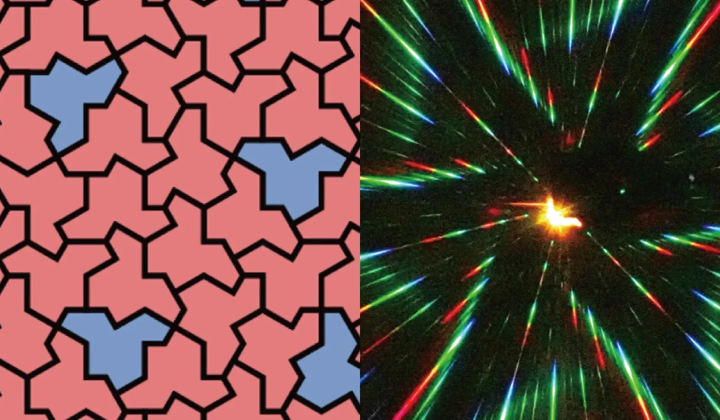
According to НВ — Техно: A long-standing mathematical puzzle has now revealed groundbreaking physical properties of light. Scientists at the Institute of Industrial Science, University of Tokyo, have experimentally showcased distinctive optical behaviors emerging from an aperiodic pattern based on the mathematical shape known as the “Smith hat.” First identified in 2023, this remarkable figure can tile a surface without repeating elements. Their findings, published in the journal Nature Communications, open new pathways for advanced optical materials and devices, particularly in controlling light polarization.
Unpacking the Geometric Structure
The “Smith hat” shape addresses the challenge of covering a surface with a single tile type, called a monotile. Researchers fabricated nanoscale versions of this structure on silicon nitride films using electron-beam lithography. When illuminated with lasers, the resulting diffraction patterns resemble propellers, indicating the structure’s chirality. Chirality means that the object and its mirror image cannot be superimposed, a crucial feature for emerging optical technologies.
The diffraction patterns vary depending on the angle and polarization of the incoming light. This demonstrates that the optical response of the structure flips when the pattern itself is mirrored. Such properties position these designs as promising platforms for next-generation optical devices and technological innovations.
This discovery marks a significant advancement in modern optics.
These results highlight the powerful role of geometric forms in developing novel functional materials. Innovations in optical technology based on this research could impact diverse fields, from telecommunications to medical equipment, where precise light manipulation is essential. Continued exploration in this area promises to revolutionize how light is harnessed in both scientific research and industry.
As researchers continue to explore the intricate relationship between geometry and light manipulation, the recent achievement of successful laser data transmission through turbulent environments underscores the growing potential of advanced optical technologies. This breakthrough complements the findings from the University of Tokyo, highlighting how innovative geometric patterns can revolutionize various fields, including communication and medical devices.

Read also