A fossil dating back 81 million years with signs of predator bites found in Canada

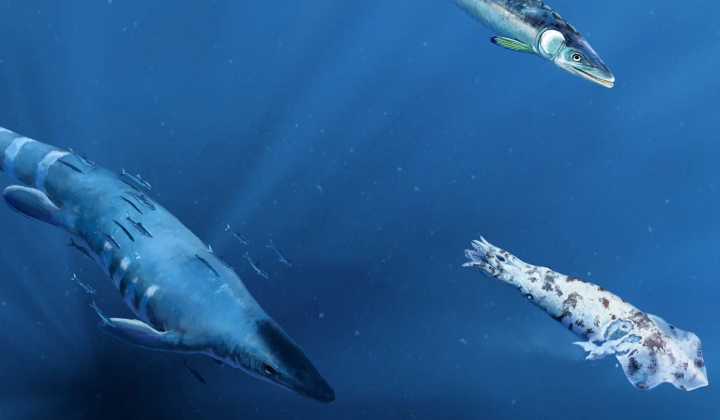
With signs of a fatal attack
According to НВ — Техно: Scientists have discovered fossil remains of a giant creature from the Cretaceous period. Paleontologists, studying the fossil found in southern Manitoba (Canada), identified two bite marks on the internal skeleton of the ancient cephalopod Enchoteuthis. This species existed around 81 million years ago in Cretaceous seas. One mark was likely made before the animal's death, while the other remains unclear. The attacker could not be precisely identified, but possible predators considered include the mosasaur Latoplatecarpus and the predatory fish Cimolichthys.
The fossil, named Q80.05.14, was collected in 1980 from the Pierre Shale. Researchers note that the specimen is approximately 49 cm (19 inches) in length and has an estimated total length of the gladius of 60 cm (24 inches). The total body length of Enchoteuthis is less than 1 meter (39 inches). The specimen is currently housed at the Canadian Fossil Discovery Centre.
Analysis of bite marks
Researchers used 3D scanning and silicone molds to analyze the bite marks. One mark, located near the front, is interpreted as a bite inflicted shortly before or during the animal's death, as it shows no signs of healing. The second mark, located near the back, could be either a second bite or damage from a separate encounter or separation of the gladius. No embedded teeth or regular intervals between teeth were found on the marks, complicating the identification of the predator.
'During the Mesozoic, cephalopods were one of the most numerous and diverse groups in the marine world. Cephalopod mollusks, including coleoids and ammonites, served as a great source of food for predators such as marine reptiles and fish.' - Melina Jobbins, paleontologist at the University of Manitoba
Excluded from the list of potential predators are sharks and the giant tylosaur due to the shape of the bites or teeth. The study also mentions a previous analysis of whale skulls near Antwerp, where paleontologists from the Belgian Institute of Natural Sciences found shark tooth fragments using CT scanning. This research emphasizes the importance of studying bite marks for understanding food webs in the Western Interior Seaway during the late Cretaceous period.
Discovering bite marks on the fossil remains of Enchoteuthis provides valuable information about ecological interactions in Cretaceous marine ecosystems. Understanding predator-prey relationships among different species can aid in reconstructing evolutionary pathways and changes in marine communities. It also highlights the importance of studying ancient fossils to explore biological and ecological processes that occurred millions of years ago.
In addition to this remarkable find in Canada, paleontologists continue to uncover significant fossils that shed light on prehistoric marine life. For instance, a recent discovery in the Egyptian desert revealed ancient shark teeth dating back to the age of dinosaurs. This highlights the diverse range of predators that existed millions of years ago. To learn more about this fascinating find, click here.

Read also