4.6-Billion-Year-Old Mineral Discovered Inside a Meteorite

Unearthing the Mineral Krotite
According to НВ — Техно: A mineral called krotite, first identified in 2011 within a fragment of the NWA 1934 meteorite, has become a landmark find in the study of extraterrestrial materials. This meteorite, which landed in Africa, contains krotite that formed roughly 4.6 billion years ago in the protoplanetary disk surrounding the young Sun. Its creation demanded extreme conditions-temperatures exceeding 1,500 degrees Celsius and very low pressure.
Krotite is a crystalline blend of calcium, aluminum, and oxygen. Beyond its significance in astronomy, this mineral also plays a role in industry, as it serves as a key ingredient in calcium aluminate cement. Researchers have further noted that dmitriivanovite, another meteorite mineral, displays a similar chemical anomaly, opening up fresh avenues for exploring cosmic materials.
Advancing Cosmochemistry
The name 'krotite' honors cosmochemist Alexander Krot from the University of Hawaii, highlighting the contributions of scientists studying such minerals. Dmitriivanovite, named after researcher Dmitry Ivanov, similarly underscores the value of scientific work in this field. In meteorites like NWA 1934, scientists have also discovered presolar grains, which can offer additional insights into the conditions that shaped our planets.
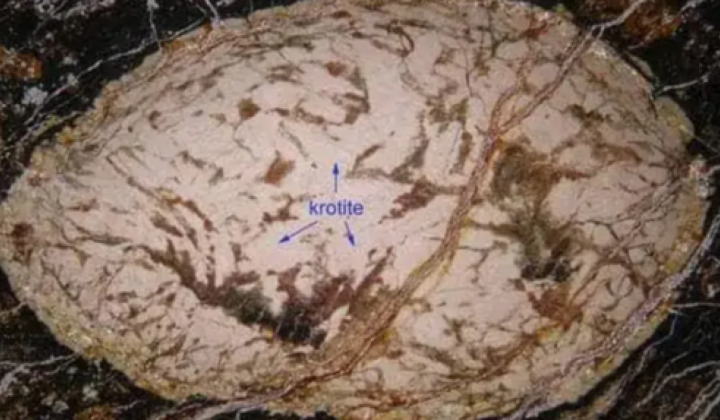
A microscope image of krotite (Photo: CalTech) reveals the details of its crystalline structure, a testament to the ancient processes that took place within our solar system. The ongoing study of minerals like krotite continues to deepen our understanding of cosmic chemistry and geology.
“The discovery of the mineral krotite and its analysis within the context of space research underscores the importance of studying meteorites to understand the evolution of our solar system.”
Knowledge about the ancient processes that occurred in the protoplanetary disk helps scientists build a more comprehensive picture of how planets and their components formed. Research into minerals such as krotite and dmitriivanovite could lead to new breakthroughs in astronomy and materials science, which in turn may impact various industrial sectors.

Read also