How Earth's Slowing Spin After the Moon's Formation Shaped Its Earliest Crust and Continents

Planetary Evolution
According to НВ — Техно: New research reveals that the gradual deceleration of Earth's rotation following the Moon's formation played a crucial role in developing the planet’s initial crust and first continents.
Simon Lock from the University of Bristol led a study demonstrating that the Earth's spin slowdown triggered significant geological changes. These changes, evolving over tens of millions of years, altered the planet's shape and influenced tectonic activity essential for crust and continent formation.
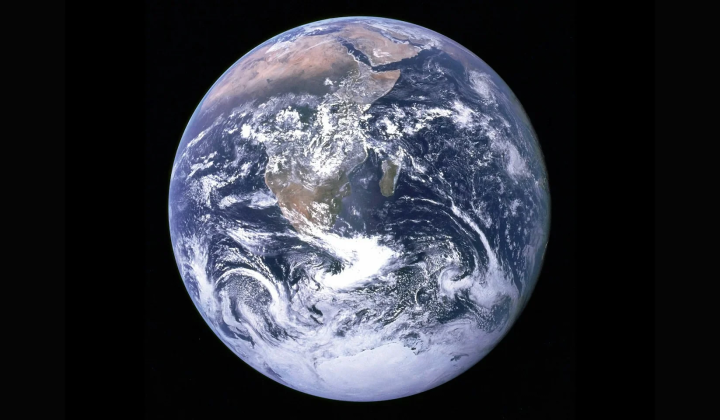
About 4.5 billion years ago, a colossal impact event gave rise to the Moon. At that time, the young Earth rotated extremely fast, resulting in days lasting only two to five hours. This rapid spin caused the planet to bulge at the equator and flatten at the poles, with the equatorial diameter nearly twice the polar height.
Gravitational forces between Earth and the newly formed Moon pushed the satellite into a wider orbit, which gradually slowed Earth's rotation. This deceleration allowed Earth to adopt a more spherical shape over time.
The centrifugal force at the equator counteracted gravity, leading to the development of a thicker crust in that region. Simultaneously, tectonic stresses stretched polar areas and compressed equatorial zones. Some compressive forces matched the intensity of those that created the Himalayas. These dynamic shifts caused water-altered rocks to subduct into the mantle, fostering the emergence of silica-rich continental crust.
Increasing pressure in the lower crust made it denser, driving it deeper into the mantle and forming distinct chemical structures.
The findings, published in the Journal of Geophysical Research: Solid Earth, highlight the significance of these processes in understanding Earth's geological evolution, according to lead researcher Simon Lock.
These insights offer valuable perspectives on Earth's early geological history and demonstrate how gravitational interactions and tectonic forces combined to shape the planet's surface. Moreover, the mechanisms uncovered may provide clues for studying the evolution of other planets with similar developmental pathways. This discovery emphasizes the need for integrative geological research to better comprehend the evolution of Earth and other celestial bodies.
In addition to Earth's rotation changes, recent studies also reveal how the Moon's cooling interior contributes to its shrinking radius over millions of years. This phenomenon not only impacts the Moon's structure but also provides insights into the broader dynamics of celestial bodies. For a deeper understanding of these interconnected processes, explore how the Moon's shrinking radius affects our planet.

Read also