Beneath Mars, Researchers Detect a Thermal Anomaly Reaching Up to 400 Degrees

The Mystery of the Two Hemispheres
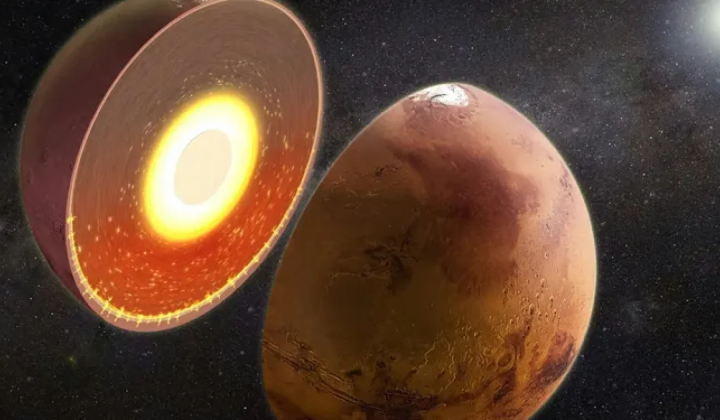
According to НВ — Техно: An analysis of archived data from three NASA probes-Mars Global Surveyor, Mars Odyssey, and Mars Reconnaissance Orbiter-has revealed that temperatures in the mantle beneath Mars’s southern hemisphere run between 200 and 400 degrees Celsius hotter than those under the north. The finding was made by Alexander Berne, formerly of the California Institute of Technology (Caltech) and now at the University of Arizona. He applied a newly developed approach called tidal tomography, which factors in the Sun’s gravitational influence.
An Underground Thermal Surprise
According to the data, the mantle beneath the southern hemisphere could still be partly molten. That may account for seismic and magnetic anomalies picked up by the seismometer on NASA’s InSight lander. The study found that seismic waves weaken more quickly in the south because of the elevated temperatures. Those heat flows may have pushed the crust above the Curie point, altering the magnetic behavior of minerals in the southern region.
The leading explanation is a collision with a colossal object more than 4 billion years ago. The impact carved out the enormous northern basin, letting the northern mantle cool faster, while the thick southern crust acted like a heat-retaining lid. Berne said:
“Planets are usually symmetric inside, but with Mars it is different.”
The same tidal tomography technique is slated for testing on Mercury and Jupiter’s moons, which could open new avenues for probing the inner structure of other bodies in the Solar System. Beyond revealing how unusual the Red Planet’s geology is, the discovery may shape the next wave of Mars research: knowing the planet’s insides is key to reconstructing its history and assessing whether it could have hosted life. It also shows how newer analytical methods might yield fresh discoveries elsewhere, expanding our view of their evolution and physical characteristics.
This groundbreaking discovery about Mars's thermal anomalies not only sheds light on the planet's unique geological features but also aligns with recent findings regarding its deep interior. For instance, the analysis of a meteorite from Mars has provided further insights into the complexities of its subsurface, revealing more about the processes that have shaped the Red Planet over billions of years.

Read also