Largest Miocene Turtles of South America: Extinct Chelus colombiana and the Newly Identified Patagoniaemys aeschyli

Breakthroughs in Turtle Paleontology
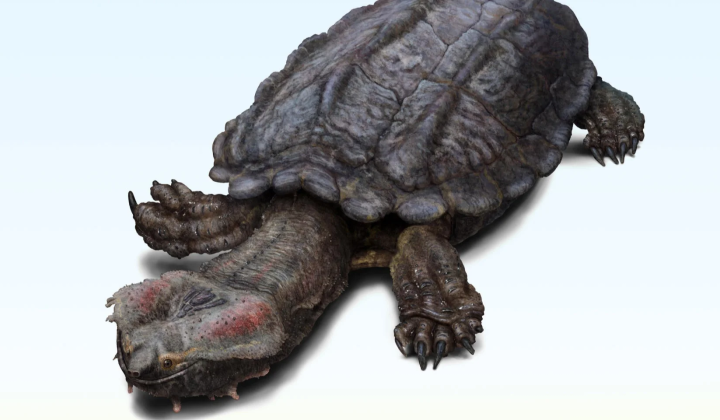
According to НВ — Техно: On October 8, groundbreaking research was published revealing new insights into the extinct turtle species Chelus colombiana, which roamed northern South America around 10 to 15 million years ago. Scientists uncovered the largest fossil specimens of this genus ever recorded, significantly broadening our understanding of their size and geographic distribution. The study also introduced Patagoniaemys aeschyli, a newly identified armored turtle species from northern Patagonia dating back to the Maastrichtian stage of the Late Cretaceous, approximately 72 to 67 million years ago.
The Story of Chelus colombiana
Chelus colombiana belongs to the freshwater turtle family Chelidae, encompassing at least 60 species. Among living members, Chelus fimbriata is the largest, with females reaching up to 52.6 cm in shell length.
This research examined two fossil shells of Chelus colombiana: specimen MUSM-920, measuring 84.6 cm in length and weighing about 65 kg, and MUSM-5003. MUSM-920 was discovered along the Inuya River in the Fitzcarrald Arch region of Peru, while MUSM-5003 was found near Iquitos in northern Peru in 2010. Both fossils are now preserved at the Natural History Museum of the National University of San Marcos in Lima.
Previously, Chelus colombiana fossils were documented in Colombia and Brazil, where they formed part of the Pebas system ecosystem dominating western Amazonia during the Miocene. The impressive size of Chelus colombiana is linked to the extent of wetland habitats rather than climatic factors. MUSM-920 represents the largest fully intact shell ever recorded for this genus and species. Its size rivals a partially preserved Brazilian specimen estimated at 77.4 cm in shell length, with an overall length approaching 90 cm. Collectively, these fossils represent the largest chelid turtles known throughout history.
Regarding the newly described armored turtle Patagoniaemys aeschyli, it belongs to meiolaniiform turtles, known for their heavily armored bodies and, in some species, horned skulls. Researchers highlight that chelids are the most diverse group of side-necked (pleurodiran) turtles alive today.
These findings significantly enrich our understanding of turtle evolution and diversity in South America across different geological periods. Studying fossil species like Chelus colombiana and Patagoniaemys aeschyli enables scientists to reconstruct ancient ecosystems and assess how environmental changes influenced species development. This research offers valuable perspectives for future studies in paleontology and evolutionary biology.
In addition to the remarkable findings regarding the massive saber-toothed marsupial Pampaluctor calibar, which has reshaped our understanding of ancient South America, these discoveries shed light on the diverse and complex ecosystems that existed millions of years ago. The evolution of these species highlights the rich paleontological history of the continent, making it essential to explore their interconnections further.

Read also