Japanese Researchers Develop Electronics That Self-Assemble and Detach on Command

Thin-Film Electronics: A Breakthrough from Japan
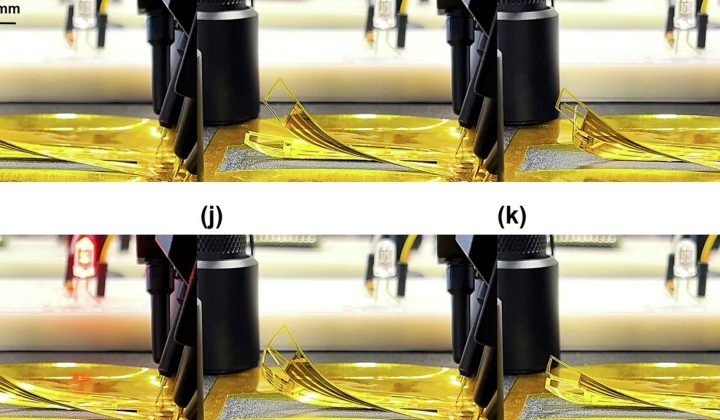
According to НВ — Техно: On July 20 at 8:00 PM, scientists from Kyushu University in Japan unveiled a new type of thin-film electronics capable of autonomously connecting, disconnecting, and reconfiguring. This innovative technology relies on an electromechanical docking mechanism that enables devices to interact with each other.
In their work, the team integrated electrical circuits with an actuator layer made from polypropylene and polyimide. A standout feature is the embedded gold microheater, which heats the film and allows the module to bend on demand. The system operates at a low voltage ranging from 5 to 12 V.
Technical Specifications and Capabilities
The probe mechanism used in the system can deform by 10 mm at a power of 1.1 W during docking. A separate detachment module consumes an average of 0.43 W and can hold a force of up to 6.1 mN. Notably, the connection remains locked and continuous even when power is completely turned off.
“Our group has been developing kinetic electronics for some time-thin-film devices with actuators and circuits that can move, attach, and work together.”
Fumihiro Sassa, Associate Professor at the Faculty of Information Science and Electrical Engineering, Kyushu University
He added that several different docking methods were developed. For instance, one can form a loop and hook onto another device. Another features a claw-like fastener that locks onto another device and remains secured even after power is cut.
The study results were published in the journal Flexible Electronics, marking significant progress in thin-film electronics and their potential future applications.
This development could have major implications for emerging technologies, particularly in robotics, biomedical electronics, and interactive devices. The ability of devices to self-connect and disconnect opens up new possibilities for creating adaptive systems that can change configuration based on user needs or environmental conditions. Innovations in thin-film electronics may also spur further research and investment in this field, boosting competitiveness in the global market.
This advancement in thin-film electronics showcases a significant leap in technology, similar to the recent innovations in quantum computing. For instance, researchers in Zurich have developed a quantum chip powered by mechanical resonators, which enhances the capabilities of quantum systems. Exploring these cutting-edge developments in electronics and quantum technology could provide valuable insights into the future of interconnected devices and their applications in various fields. Learn more about this breakthrough in quantum chip technology.

Read also