Astronomers Discover Pulsar Racing Beyond Its Supernova Shockwave at Over 1400 km/s

Cosmic Speedster Breaks Free
According to НВ — Техно: A team of international astronomers, led by Rohit Dokara-formerly of the Max Planck Institute for Radio Astronomy-has identified a pulsar traveling faster than the shockwave of its own supernova explosion. This pulsar’s velocity exceeds 1400 kilometers per second, ranking it among the fastest known compact objects within the Milky Way.
Unraveling the Pulsar's Journey
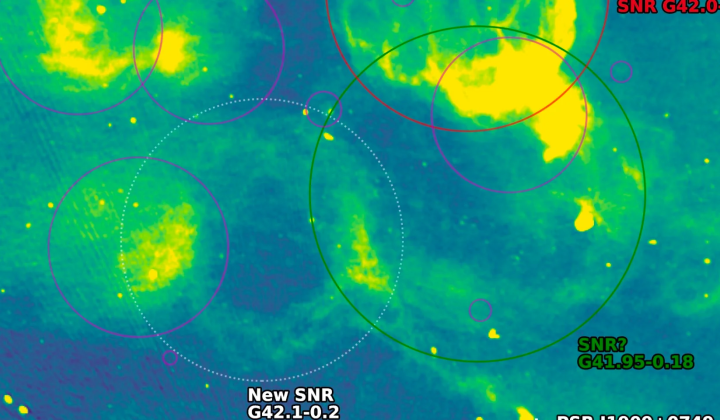
Research reveals that this pulsar has propelled itself beyond the gaseous shell created by the supernova explosion, moving well past the surrounding cloud of gas and dust left behind. Such an occurrence is exceptionally rare, as pulsars typically do not outpace the expanding supernova remnants. Only a handful of pulsars have been documented moving faster than their supernova shells.
The discovery was made possible by analyzing two decades of archival radio survey data alongside observations from the MeerKAT telescope. The pulsar’s trailing gas tail points directly back to the center of the supernova remnant, offering valuable clues about the mechanisms driving its extraordinary acceleration. While astronomers estimate there are roughly 2000 supernova remnants scattered throughout the Milky Way, only about 400 have been detected to date.
This breakthrough highlights the critical role of next-generation telescopes with enhanced sensitivity, which enable the detection of elusive objects and deepen our understanding of neutron star acceleration processes. The findings have been accepted for publication in the journal Astronomy & Astrophysics, underscoring the importance of this milestone for the field of astronomy.
Discovering a pulsar that outpaces the expansion speed of its supernova shell carries profound implications for our comprehension of stellar evolution and the forces shaping star deaths. This insight sheds new light on the physical phenomena occurring during supernova explosions and the formation and evolution of neutron stars. Continued study in this area promises further revelations that will broaden our grasp of the universe.
The dynamics of supernova remnants play a crucial role in shaping stellar populations across galaxies. Understanding how these shock waves influence star formation can provide valuable insights into the processes driving the evolution of celestial bodies. To explore this fascinating connection, learn more about how shock waves in the Milky Way's bar affect star formation differently than in neighboring galaxies.

Read also