How Shock Waves in the Milky Way’s Bar Drive Star Formation Differently from Nearby Galaxies

The Milky Way’s Distinctive Star-Birth Process
According to НВ — Техно: Unlike its neighboring galaxies, the Milky Way’s central bar structure generates powerful shock waves that play a crucial role in star formation.
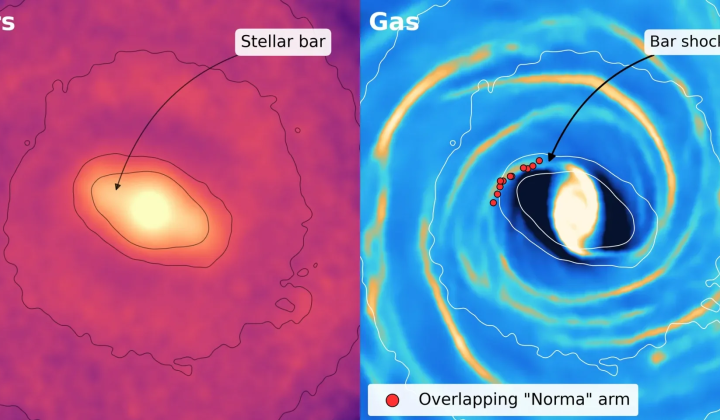
An international team of astronomers led by Dr. Hillary Davis from the University of Sydney has uncovered that the Milky Way produces stars through mechanisms unlike those observed in nearby galaxies. Their findings, published in Nature Astronomy, focus on the galaxy’s central bar-an immense feature stretching approximately 14,000 light-years. This bar creates intense shock fronts that compress clouds of gas, triggering widespread star formation.
By studying microwave masers previously linked to the Norma spiral arm, researchers found these phenomena align precisely with the shock fronts at the edge of the galactic bar. This allowed the team to refine measurements of the bar’s size, tilt, and rotation speed, confirming its direct influence on the active star-forming regions along the shock waves.
Dr. Hillary Davis emphasized, “The Milky Way forms stars in a manner that is fundamentally different from most of its neighboring galaxies.”
This discovery highlights the Milky Way’s rare status as a galaxy with vigorous star formation driven by shock waves in its bar. However, studying these processes is challenging due to our position within the galaxy and the dense cosmic dust clouds that obscure observations.
Implications for Astronomical Research
These new insights mark a significant advancement in understanding the Milky Way’s structure and star-forming activity, reshaping existing models. Beyond emphasizing our galaxy’s uniqueness, this research offers valuable perspectives that could enhance studies of galaxy evolution across the universe by illuminating the complex mechanisms behind star birth.
In addition to the unique star formation processes in the Milky Way, understanding the dynamics of massive stars provides further insights into our galaxy's evolution. For instance, recent research has revealed how two significant stars in IRS 16SW interact with Sagittarius A*, the supermassive black hole at the galaxy's center. This relationship highlights the complexity of galactic structures and their influence on star formation and black hole feeding mechanisms.

Read also