Budget Deadlock 2026-2027: There Will Be Enough Money Until New Year. What Comes Next?

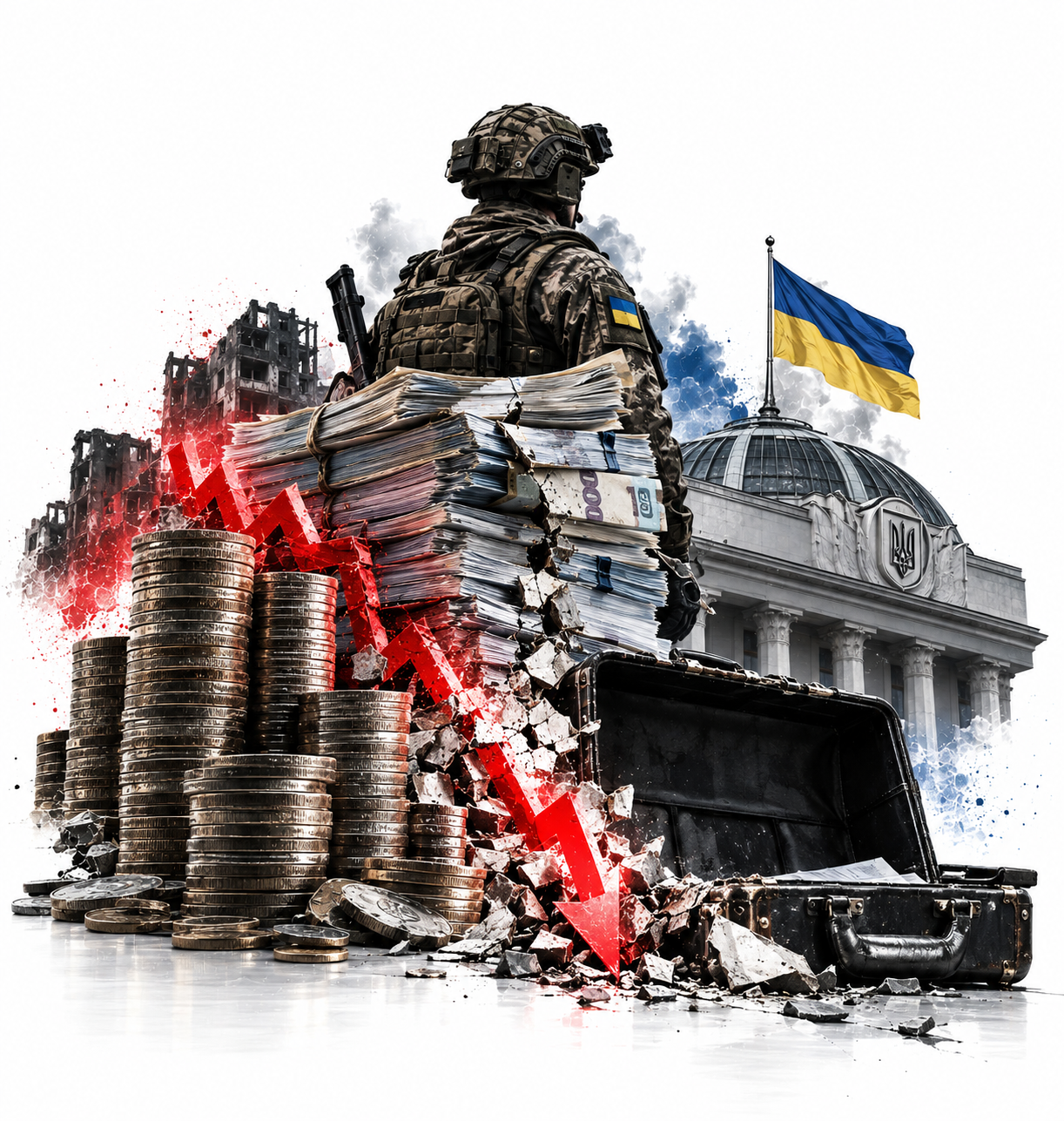
The financial situation of Ukraine has again reached a point where accounting is almost indistinguishable from military logistics. President Volodymyr Zelensky stated in September that there is approximately $27 billion in unmet funding needs for defense. This figure is no longer just an abstract deficit for the next year: Kyiv is currently looking for money for missiles, drones, munitions, and for maintaining the pace of the war.
Ukraine needs about $27 billion for defense, while the draft budget for 2027 anticipates attracting a record $52.6 billion in international support. However, the old formula - “the West funds the civilian budget, Ukraine pays for the war itself” - is changing. The EU has started to directly finance defense procurement. Therefore, the main problem now is not the absolute lack of money, but whether the volume, purpose, and timing of funds will align with the increasingly expensive war.
Thus, the question of whether the budget will “last until New Year” sounds more dramatic than the financial reality suggests. The government’s baseline scenario does not foresee a formal budget collapse before the end of 2026. However, this does not mean that the problem is solved. It means that the state is increasingly combining internal taxes and borrowings with international tranches and direct external financing of defense needs.
This is where the main rule change begins.
The Old Taboo is No Longer Absolute
The thesis that Western money is “categorically forbidden” to be spent on the army used to describe the structure of the Ukrainian budget quite well. Internal revenues were primarily allocated for defense, while international assistance allowed for paying pensions, salaries to budget workers, and funding healthcare and other civilian expenditures.
In 2026, this boundary began to blur.
The European Union has created a separate Ukraine Support Loan of €90 billion for 2026-2027. Its structure is fundamentally important: about €30 billion is allocated for macro-financial support, and €60 billion for defense needs, including the procurement of military goods and the development of Ukrainian and European defense industries.
This is not just a legal detail. It changes the entire budgetary arithmetic of war.
On September 17, the European Commission announced an additional €3.3 billion, and the very next day Prime Minister Serhiy Korotkyi reported their receipt. The funds are intended specifically for critical defense needs - including missiles and drones.
Thus, the old formula “the West pays only for civilian state needs, while Ukraine pays only for the army” is no longer literally valid. Europe is already financing both parts of the bill.
The problem does not disappear as a result. It simply becomes more complex.
Until December 31: The Financial Fire Brigade Mode
By the end of the year, the Ministry of Finance will have to balance several streams at once. Internal taxes remain the foundation of defense expenditures. State borrowings through government bonds provide another channel for financing. International partners support the civilian part of the budget, while new European mechanisms increasingly penetrate directly into defense.
At the same time, international money is not unconditional. Part of the tranches is tied to reforms and the fulfillment of commitments to the EU and the IMF. The September story regarding the tax on cheap foreign parcels clearly illustrated the mechanics: after the first unsuccessful voting attempt, the head of the parliamentary financial committee estimated the potentially at-risk funding from the EU and IMF at about €4 billion, even though the tax itself was supposed to bring only about 10 billion UAH to the budget per year.
This is a good example of contemporary Ukrainian budget mathematics. A small figure inside the country can unlock a much larger figure from the outside.
Therefore, Kyiv is now not so much “zeroing out the last reserves,” but managing a complex system of dependencies: taxes, government bonds, IMF, EU, defense loans, bilateral assistance, and ally procurements. Each stream has its own calendar and conditions.
In a peaceful state, this would be the treasury’s job. In a warring one, it is part of defense planning.
2027: The Bill is Already Issued
The draft state budget for 2027 clearly illustrates the scale of the problem. Total expenditures are planned at the level of 7.272 trillion UAH, while revenues are projected at 5.648 trillion UAH. The government wants to allocate 4.885 trillion UAH for defense and security, which is 43.8% of the projected GDP. This is approximately UAH 518 billion more than the adjusted plan for 2026.
However, the most important figure lies below: Ukraine needs $52.6 billion in international support in 2027. The government cites the European Union, G7 countries through the ERA mechanism, the IMF, the World Bank, Great Britain, and other partners as sources.
This is significantly higher than the initial estimate of $30-35 billion.
And here it is worth avoiding another extreme: this $52.6 billion does not mean that such a sum “does not exist.” A significant part of future support relies on already established mechanisms. The EU, for instance, has legally approved €90 billion in support for 2026-2027. The problem lies in how many of these resources will remain available precisely in 2027, what the timeline will be for their arrival, and what additional sources will be secured.
In other words, this is not an empty cash register. It is a cash register in which some of the money already has an owner, some has a timeline, and some has conditions for receipt.
$52.6 Billion - Not One Hole
This is where it is easy to make a mistake by adding all the figures into one large budgetary abyss. $27 billion in defense needs, $52.6 billion in international financing, and the state budget deficit are interconnected but not identical quantities.
For example, the Ukraine Facility of €50 billion is designed for the entire period of 2024-2027. As of the end of June 2026, the EU reported that €42 billion had already been mobilized under this mechanism. Therefore, it is impossible to simply list all €50 billion in the “money for 2027” column.
Likewise, the €90 billion Ukraine Support Loan is distributed between two years and two major areas. According to the projected structure, €30 billion is allocated for economic support, while €60 billion is meant for defense. For 2026, the EU has provided access to approximately €45 billion from this mechanism.
Thus, the main question of 2027 will not be the total size of beautiful multi-year packages. It is far more mundane: how much live money will be available in a specific month when the Ministry of Finance or the Ministry of Defense needs to pay a specific bill?
War is Becoming More Expensive than the Budget
There is yet another problem that cannot be resolved through simple accounting rearrangement. The war is technologically becoming more expensive.
Russia is increasingly using reactive strike drones that are harder to intercept with inexpensive mobile groups. Reuters reported that Ukraine is seeking new interception means, but their mass production is hindered, among other things, by financial constraints.
This is the economy of War 4.0. It is not enough to have money for one Patriot or one batch of drones. It is necessary to continuously fund the race of generations: if the opponent changes Shahed - a new interceptor is needed; a new tactic emerges - new sensors are required; a cheap drone forces the launch of an expensive missile - a cheaper response has to be created.
As a result, the military budget ceases to be merely a large figure. It becomes a moving target.
The Main Scissors of 2027
Therefore, the real “budget scissors” look somewhat different from the initial version of this story.
On one hand, Ukraine has an unprecedentedly large external financial contour. The EU has already agreed to €90 billion for 2026-2027, with two-thirds approximately earmarked for defense. Adding to this are the ERA, the IMF, bilateral assistance, and other programs. Saying that the West does not fundamentally finance the Ukrainian army is already practically incorrect.
On the other hand, the Ukrainian budget for 2027 is based on the need to attract $52.6 billion in international support, while defense and security expenditures amount to 4.885 trillion UAH. This means that the financial stability of the state will depend on the simultaneous operation of many channels, none of which alone closes the entire bill.
Before the New Year, this system will likely operate not due to one large solution but through dozens of smaller ones. One tranche will close the missiles. Another will address the civilian budget. Government bonds will provide liquidity within the country. Tax changes will help meet the IMF and EU conditions. New agreements with partners will close the next quarter.
And then the calendar will start again.
Therefore, the main threat of 2027 is not necessarily formal default or the literal absence of money from Western partners. A more dangerous scenario is the gap between the speed of war and the speed of funding: when the required resources exist politically but have not yet been formalized legally, have not been distributed among programs, or arrive later than needed at the front.
Ukraine already knows the approximate price for the next year: 4.885 trillion UAH for defense and security and $52.6 billion in required international support.
The problem with the 2027 budget is not that there is no one to present the bill to. The problem is ensuring that the money arrives before the deadline to pay it.

Read also