List of 30 Words That Never Need a Comma, According to a Linguist

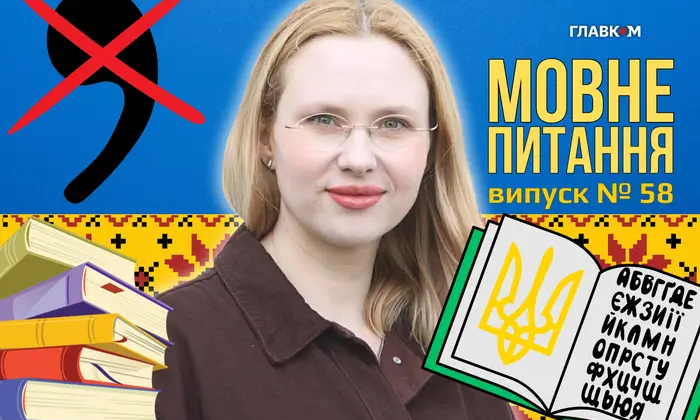
Language Matters on 'Glavkom'
According to Главком: In the 'Language Matters' column on 'Glavkom', linguist Olha Vasylieva has tackled key aspects of Ukrainian punctuation, specifically the rules for words that are not parenthetical. The article provides answers to ten reader inquiries about Ukrainian vocabulary, spelling, and feminatives. Notably, it highlights that a comma should never be placed before the compound conjunction 'shchob'. This column serves as a practical guide for English-speaking learners of Ukrainian who often struggle with punctuation nuances.
Readers are encouraged to send their questions to [email protected] with the subject line 'Language Matters'. For instance, Alina Ostrozka asked:
“Help! I get asked every day. How do I translate those 'ryebyat'?”
Oleksandr Stukalo was curious about the cringiest spelling rule, while Serhii Osoka inquired about the correct translation of the word 'sokovyzhymalka'.
Olha Matviienko asked whether the word 'nadykhayuchyi' should be used, and Anatolii Sahan pointed out why the word 'rozkoshelytysia' appears in textbooks but not in dictionaries. Maryna Khiperska also wanted to know the correct usage of 'nul hodyn' versus 'nulova hodyna'.
Reader Words and Questions
The article lists thirty words and phrases that are not parenthetical:
- vidtak
- vodnochas
- vochevyd
- vse-taky
- vse zh
- do toho zh
- zazvychai
- zdeblishoho
- z povahoiu
- inodi/inkoly
- movby/movbyto
- navit
- nasampered
- naspravdi
- natomist
- nache/nenache
- nachebto/nibyto
- peredusim/peredovsim
- pryinamni
- prytom/prychomu
- tym bilshe/tym pache
- tym chasom
- tobto
- tozh
Additionally, Vladlen Serhiienko asked how to beautifully translate the Russianism 'dostoprimechatelnost' into Ukrainian, and Oksana Zhuravko inquired about the plural forms of 'sklo' and 'dno'. Kostiantyn Arefiev asked about the gender of the word 'makak', and Valerii M. raised a question about the book title 'Hrybnykh sprav pidmaistra'.
According to Ozhegov's dictionary, 'rebiata' translates as 'young people, guys'. Ukrainian spelling also disregards the 'rule of nine' in cases like 'strit, ale river'. In the Dictionary of the Ukrainian Language (SUM-20), 'nul hodyn' is given as '24 hodyny', and the plural forms 'stekla' and 'dena' are confirmed by the online dictionary of the Language Information Fund of the National Academy of Sciences of Ukraine.
The word 'sklo' comes from Polish (szkło), and in Hrinchenko's dictionary, the singular form 'steklo' is recorded. The word 'nadykhalnyi' also appears in Karavanskyi's dictionary. Thus, the 'Language Matters' column continues to actively respond to reader questions, expanding their knowledge of the Ukrainian language.
The 'Language Matters' column on 'Glavkom' serves as an important resource for those seeking to improve their understanding of Ukrainian grammar and spelling. By regularly submitting questions, readers not only receive answers to specific issues but also gain practical recommendations for language use. This reflects a growing interest in linguistic subtleties and a commitment to using Ukrainian in its correct and modern form.
Understanding the intricacies of Ukrainian punctuation can be quite challenging, especially when it comes to specific rules about word usage. For those eager to delve deeper into the fascinating world of language, our previous article explores various spelling conventions and peculiarities in the Ukrainian language. Check out the insights on quirky words and spelling nuances that can enrich your understanding and usage of the language.

Read also