Spanish Citizenship — How to Obtain and the Conditions for Ukrainians


Spain remains a favorable country for migration, even now when the global economy is not in the best state. It is important to understand how to obtain Spanish citizenship and whether it is at all accessible to Ukrainians, or if the only option remains refugee status. All these nuances are important if you intend to obtain Spanish citizenship in a short time frame.
Obtaining Spanish citizenship is also a complex procedure that requires preparation. Some stages can be completed independently, while others require the involvement of specialists. In general, the conditions for obtaining Spanish citizenship may change, so it is important to keep track of all updates.
Main Grounds for Obtaining Spanish Citizenship
Obtaining Spanish citizenship is a complex legal procedure regulated by national legislation and international agreements. Citizenship of the Kingdom of Spain grants individuals a full range of rights and freedoms, including the right to reside, work, and participate politically in all countries of the European Union. The main legal act in this area is the Civil Code of Spain, Articles 17-28 of which detail the conditions and grounds for acquiring legal status. For foreign citizens, including Ukrainian citizens, the main path to a Spanish passport is naturalization after a prolonged legal residence in the country.
In addition, there are special programs for descendants of Spanish citizens and individuals who lost their citizenship in the past. The state imposes clear requirements on candidates, including mandatory knowledge of the Spanish language, integration into society, and the absence of convictions. The procedure includes several stages from gathering documents to taking exams and participating in an official ceremony.
The relevance of the information for the year 2026 is conditioned by the fact that Spanish legislation may undergo changes, so it is essential to refer to official sources or professional lawyers. Spanish citizenship is attractive to many foreigners due to the country’s stable economy, high standard of living, and the ability to move freely within the EU. Conditions and procedures may differ for citizens of different countries depending on the existence of bilateral agreements, such as agreements with Ibero-American countries, Andorra, the Philippines, Portugal, and France. For Ukrainians, the process has its specific features related to the need to obtain prior residency permits. Careful study of all requirements and preparation of necessary documentation is a key factor for success in obtaining a Spanish passport.
Spanish legislation provides for several legitimate grounds for acquiring citizenship, each of which has its specific conditions and procedures. The most common path for foreigners is naturalization through residency, which requires legal residence in the country for a defined period. The general term of residence is ten years, but there are significantly shorter terms for certain categories of individuals. A special ground is the option that grants citizenship to those under the guardianship of Spanish citizens, as well as to adult children and grandchildren of those who were deprived of Spanish citizenship in the past.
The Republic also provides the possibility of restoring citizenship for those who lost it for various reasons, such as permanent residence abroad without registration at the consulate. Simplified procedures apply for citizens of Ibero-American countries, Andorra, the Philippines, Equatorial Guinea, and Portugal, for whom the mandatory residence period is reduced to two years. Spouses of Spanish citizens can apply for citizenship after one year of legal marriage and actual cohabitation in Spain, provided that the marriage has not been annulled. Widows and widowers of Spanish citizens also have the right to an accelerated procedure under similar conditions. Individuals born in Spain to foreign parents, if at least one parent was also born in Spain, acquire the right to citizenship. Children born in Spain of stateless parents or if the parents do not pass on their citizenship automatically become citizens.
Individuals who have been under the care, guardianship, or upbringing of a Spanish institution or citizen for two years may also apply. The law also provides for the granting of citizenship at the discretion of the government in exceptional cases, for instance, for exceptional merits to the state, although this practice is rare.
Spanish Citizenship for Ukrainians
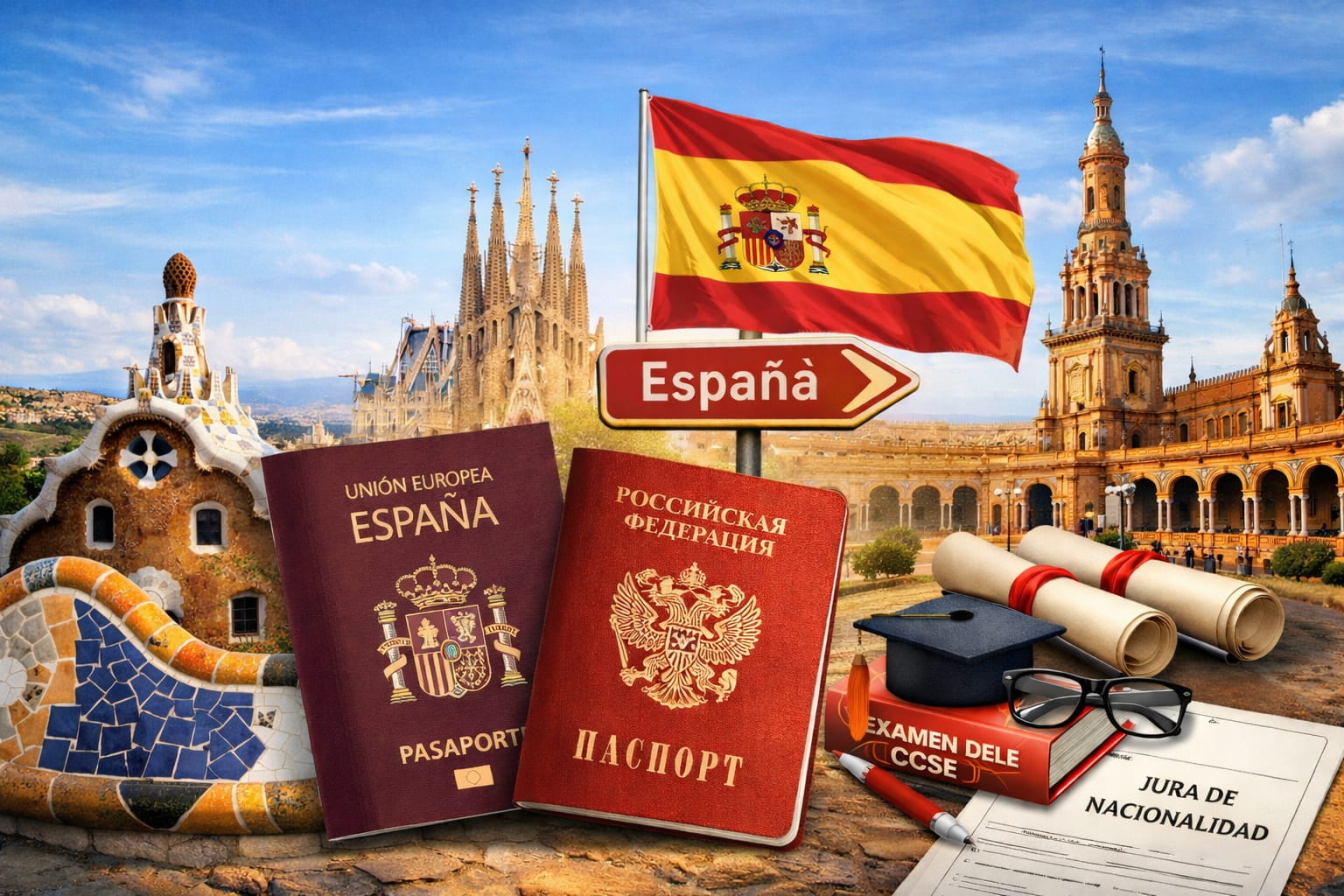
For Ukrainian citizens, the main path to obtaining Spanish citizenship is naturalization after prolonged legal residence in the country, since there is no special bilateral agreement between Ukraine and Spain that would shorten the standard ten-year term. Ukrainians must first obtain and legally reside in Spain on the basis of one of the types of residence permits, such as a work or student visa, residence permit for family reunification, or refugee status. Time spent in Spain on a student permit is counted only halfway toward the necessary ten-year term for naturalization.
Ukrainian citizens who are married to a Spanish citizen may apply for citizenship one year after the marriage is registered, provided that they have lived together in the country. A crucial condition for Ukrainians is the necessity to renounce their national citizenship since Spanish law, as a general rule, does not recognize dual citizenship for citizens of countries with which there is no corresponding agreement. Ukrainian citizens are required to officially contact Ukrainian authorities to renounce their citizenship after obtaining Spanish citizenship. The procedure requires taking exams in the Spanish language and the constitutional order of Spain at the Cervantes Institute or through the DELE academic center. For Ukrainians who are descendants of Spanish citizens, especially those who were forced to emigrate during or after the Spanish Civil War, a citizenship acquisition program based on descent may be available through the option procedure that does not require ten years of residence.
If Ukraine is granted the status of a country whose citizens can enter Spain without a visa for an extended period, it does not affect the conditions for obtaining citizenship, as it is indeed about legal residency. For Ukrainians who have received refugee status or additional protection in Spain, the period of residence is counted in full for subsequent naturalization. It should be noted that all Ukrainian documents, such as birth certificates, marriage certificates, or certificates of no criminal record, must be translated by an officially certified translator and apostilled according to the Hague Convention.
Conditions for Residence and Naturalization

Successful naturalization as a path to Spanish citizenship requires strict compliance with a set of stringent conditions established by law. The primary condition is continuous and legal residence in Spain for a defined period, which is ten years for most foreigners. Legal residence implies being present on the basis of a valid residence permit or visa that allows long-term residency. Any prolonged exits from the country may interrupt this period, making it essential to adhere to the limits on stays abroad established for residents.
Exam and Language Requirements
An important condition for acquiring Spanish citizenship through naturalization is confirmation of a sufficient level of integration into Spanish society, which includes the ability to communicate in the official language and knowledge of the basic constitutional order. To this end, foreign citizens, including Ukrainians, are required to successfully pass two mandatory exams: DELE (Diplomas de Español como Lengua Extranjera) at level A2 or above and CCSE (Prueba de Conocimientos Constitucionales y Socioculturales de España). The DELE exam is an official certificate confirming proficiency in the Spanish language, awarded by the Cervantes Institute on behalf of the Ministry of Education of Spain. Level A2 demonstrates the ability to understand and use everyday expressions related to basic daily needs.
The CCSE exam checks the candidate's knowledge of the constitutional, social, and cultural structure of Spain and includes questions about the country's history, geography, society, and culture. Preparation for CCSE is often conducted through the official website of the Cervantes Institute, where educational materials and sample tests are available. Exempt from Spanish language and constitutional exams are individuals from countries where Spanish is the official language, as well as minors under 14 years old and those who have a certificate of secondary or higher education obtained in Spain. Persons with disabilities or serious health issues that affect their ability to take exams may submit appropriate medical documents for exemption. Each exam can be retaken an unlimited number of times in case of failure, but this requires additional time and financial costs.
Certificates of successful completion of the DELE and CCSE exams are mandatory documents to be attached to the citizenship application and must be valid at the time of submission. Failure to meet this requirement, namely the absence of the proper certificates, automatically results in a rejection of the application. Therefore, planning and preparation for these tests are critical stages of the entire citizenship acquisition process. The CCSE exam can be taken in Spain, as well as in some countries abroad at authorized centers, while DELE is available in a global network of Cervantes Institute centers.
Processing Times and Passport Acquisition

The administrative procedure for processing applications for Spanish citizenship is lengthy and multi-stage, with the overall time potentially varying significantly depending on various factors. The official processing time for an application at the Ministry of Justice of Spain is up to 24 months from the moment of submission of a complete package of documents in the register. During this period, verification of the submitted documents is conducted, and requests are made to various state bodies to confirm the legality of residence, lack of convictions, and other criteria. The actual wait time often exceeds the declared two years and can reach three to four years, especially during periods with a high number of applications received.
The applicant can track the status of their case online through the electronic system of the Ministry of Justice using the assigned registration number (Número de Registro). After a positive decision regarding the granting of citizenship, an official notification is sent, and the candidate is invited to take an oath of allegiance to the King and the Constitution of Spain before a court registrar. This procedure must be completed within 180 days from the date of notification, otherwise, the positive decision may be annulled. After taking the oath and receiving the corresponding act (Acta de Juramento), the person is officially considered a citizen of Spain. The next step is to obtain the Spanish identification document.
For this, it is necessary to contact the police department for the issuance of documents (Comisaría de Policía) to fill out the required form and submit a copy of the oath act and photographs. The production of the first passport or national identity card (DNI) by standard procedure takes up to 30 working days. There is an option for expedited processing of documents for an additional fee, which reduces this time frame. The overall cycle from the beginning of document collection to obtaining the passport in hand can take from five to seven years. For those living abroad, the document submission procedure is carried out through the Spanish consulate in the country of residence, which can significantly increase the overall timeline due to the need for diplomatic correspondence. Any delays in document submission, inaccuracies, or the need for additional checks continue the process. Therefore, potential applicants are advised to initiate the procedure as soon as they acquire the right to it and thoroughly prepare all necessary papers.
Reasons for Citizenship Denial
Denial of Spanish citizenship is a legally justified decision made by authorized bodies upon detection of violations of established legal criteria or the presence of prohibited circumstances. One of the most common reasons is the failure to submit a complete package of documents or submitting documents that do not meet the established requirements. Such reasons include the absence of an apostille on foreign documents, expired dates of validity, or an uncertified official translation into Spanish.
Failure to comply with the condition of continuous and legal residence for the necessary period is a serious basis for denial. Any prolonged periods of stay outside Spain exceeding the allowed limits for residents, or living on the basis of an invalid or expired permit, leads to disqualification of the applicant. The absence of DELE certificates (level A2 or above) and CCSE, or failure to pass these exams automatically renders the application submission impossible.
Applicants also often face denial due to inability to confirm a sufficient level of income or having legal sources of funding for self-support, which is verified through tax declarations or employment certificates. Having a criminal record in Spain or abroad for crimes equivalent to serious offenses under Spanish law is an absolute barrier to acquiring citizenship. Providing false information or forged documents leads not only to immediate denial but can also result in administrative or criminal liability. Failure to meet the requirement of renouncing previous citizenship (where this is not provided for by bilateral agreements) is also a significant reason for denial.

The applicant must provide evidence that they initiated the procedure to renounce their citizenship of their country of origin. A threat to national security, public order, or Spain's international relations from the applicant is a significant reason for denial based on security service findings. Violations of Spanish tax legislation, such as tax evasion or debts to social funds, can also lead to a negative decision. All refusal decisions are accompanied by a written justification referencing the violated legal norms, which gives the applicant the right to administrative appeal within one month from the date of notification. Resubmission after denial is only possible after rectifying the reasons that led to it and after a specific period, often two years.
Overall, Spain remains a good option for obtaining citizenship. However, it is necessary to consider many nuances.

Read also