Essential Public Datasets for Effective HR Analytics

The Critical Role of Public Datasets in HR Analytics
According to AIHR: Leveraging public datasets is a cornerstone of modern, data-driven human resources practice. This article reviews key datasets, outlines selection criteria, and provides concrete examples for analyzing employee turnover, attendance, compensation, and other vital metrics. A Gartner study reveals a significant gap, finding that only 24% of HR functions believe they extract maximum value from their HR technology. This highlights a pressing need for improved data strategies to meet business objectives. In today's competitive landscape, effective people analytics is no longer optional but a strategic necessity for organizational success.
Concern is amplified by the fact that only 35% of HR leaders are confident in their technology approach's effectiveness for achieving business goals. Alarmingly, two out of three HR leaders believe their effectiveness will decline without improved technology utilization. In this context, a foundational Human Resources dataset can serve as a powerful tool, containing core HR data points such as:
- Employee demographic information
- Engagement and satisfaction scores
- Salary ranges by position
- Recruitment expenditure
- Performance metrics
Key Public Datasets for HR Analysis
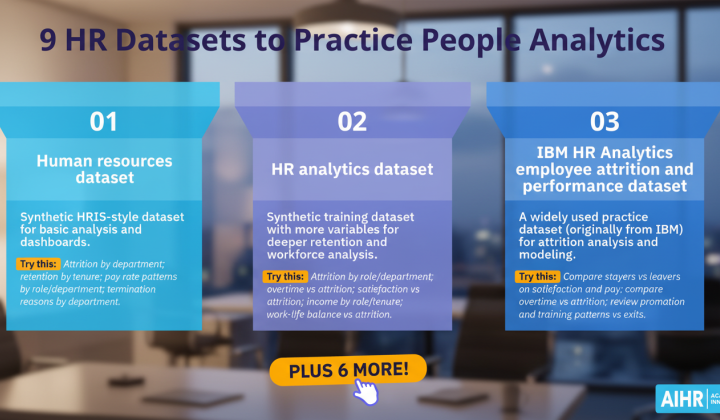
Several other valuable public datasets are available for in-depth HR analysis, including:
- The HR analytics dataset, featuring 1,480 records with metrics on attrition, job context, compensation, work patterns, employee experience, tenure, and career progression.
- The IBM HR analytics employee attrition and performance dataset, containing 1,470 records and 35 variables covering attrition, department, role, monthly income, overtime, job satisfaction, and tenure.
- The Employee attrition dataset, which includes data on business travel, commute distance, career history, manager relationships, and educational background.
- The Absenteeism at work dataset, comprising 8,336 records and 13 variables like annual absence hours, department, job title, work location, and service time.
- The Pay equity dataset, detailing job title and department, salary, gender, tenure, age, performance rating, education, and contract percentage.
- The Campus recruitment dataset, covering employment status, salary, academic scores, educational background, work experience, and employability test scores.
- The Remote work and mental health dataset, which includes work location, weekly hours, work-life balance rating, stress level, mental health condition, and productivity change.
For practitioners aiming to build a custom dataset, a structured approach is recommended:
- Select a specific practice area for focus.
- Begin with a basic employee roster.
- Add two to four key columns for targeted analysis.
- Export the data in CSV format.
- Incorporate realistic data variations and conduct thorough validation before analysis.
Integrating public datasets into HR analytics is a vital step for enhancing HR function efficacy and driving strategic business outcomes. As competition for talent intensifies, sophisticated human capital management becomes a critical differentiator. Adopting and adapting advanced data tools within HR practices can significantly influence business performance and improve overall organizational health.

Read also