Iran's 456-Hour Internet Blackout During Missile Strikes: The Mechanics of Control

Information Blackout in Iran: The Events of February 2026
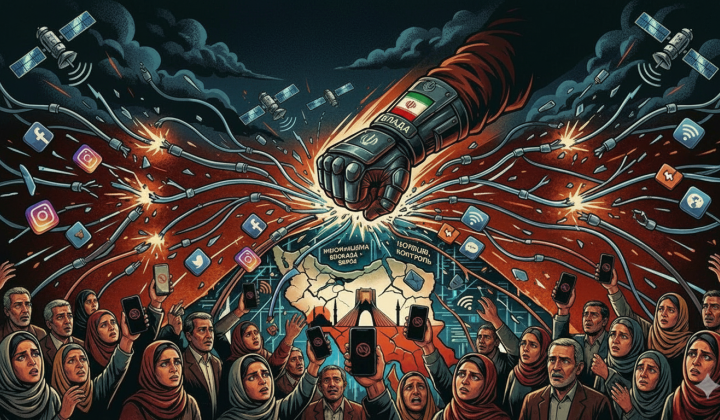
According to ХВИЛЯ: During a period of missile strikes in February and March 2026, the Iranian government imposed a near-total shutdown of external internet access for 456 consecutive hours. This move was a key part of a strategy to control the information landscape and shape public perception, executed through the National Information Network, often referred to as the Halal Internet. In response, civil activists worked to establish alternative alert systems to bypass the blockade. Meanwhile, access to satellite internet services like Starlink was criminalized. This incident highlights how modern authoritarian regimes can weaponize digital infrastructure during times of crisis.
According to information from various sources, the total information blockade was activated during the missile attacks that began on February 28, 2026. Immediately following the first explosions, approximately 98% of the country's external internet traffic was blocked, with the blackout lasting over 456 hours. For decades, Iran has invested billions of dollars in developing its National Information Network, a system analogous to China's Great Firewall and Russia's Sovereign Internet. The state has centralized all internet traffic exchange points and international gateways under the control of entities affiliated with the Islamic Revolutionary Guard Corps (IRGC).
Societal Response and Alternative Channels
A similar information blockade was deployed during the 12-day war in June 2025 and the suppression of protests in January 2026. In early March 2026, government spokeswoman Fatemeh Mohajerani stated that stable internet was provided only to those 'capable of broadcasting the voice of the government.' This system is implemented through so-called 'white SIM cards,' further restricting ordinary citizens' access to information resources.
Faced with this situation, users sought alternatives to circumvent censorship. During the February blackout, around 9.6 million Iranian users connected daily via the Psiphon tool. Specifically, Conduit reported over 5 million active sessions from Iran as of February 27, indicating that more than 10% of the country's population was actively seeking ways around the restrictions. By early 2026, between 50,000 and 100,000 Starlink terminals had been smuggled into Iran. However, in 2025, the Iranian parliament passed legislation criminalizing their use, with penalties ranging from two years in prison for personal use, up to five years for smuggling, and the potential for the death penalty if used to transmit data deemed harmful to state security.
Civil activists also attempted to create platforms to inform the public about the situation in the country. A group of engineers and digital rights specialists from Holistic Resilience deployed a platform named Mahsa Alert, in honor of Mahsa Amini, whose death in 2022 catalyzed widespread protests. However, government-aligned IT groups attempted to take down the Mahsa Alert servers using DDoS attacks.
Simultaneously, ceasefire agreements announced on April 8, 2026, contained no stipulations for the restoration of free internet access. These agreements focused on missile programs, uranium enrichment, funding for proxy groups, and de-escalation along borders. While U.S. President Donald Trump and Secretary of State Marco Rubio expressed concern over human rights violations in Iran, this did not alter the reality of the information blockade. The events in the Middle East in early 2026 serve as a critical lesson on the role of cyberspace and information control in modern conflicts.
Iran's information blockade illustrates the complex interplay of modern technology within political and social conflicts. Controlling information, particularly by restricting internet access, has become a vital tool for governments seeking to maintain power and curb civil initiative. In an era of increasing globalization and dependence on information technology, such actions can have profound consequences not only for domestic politics but also for international relations and human rights.
The recent blackout in Iran is not an isolated incident; it reflects a broader trend of internet restrictions employed by the government during times of crisis. Similar tactics were seen during previous conflicts, such as the events in June 2025. For a deeper understanding of how data regarding attacks manages to reach the outside world despite these efforts, explore more about the resilience of communication channels in our detailed analysis here.

Read also