JPMorgan Identifies Most Probable Outcome for the War in Ukraine

JPMorgan Chase Report on the End of the Russia-Ukraine War
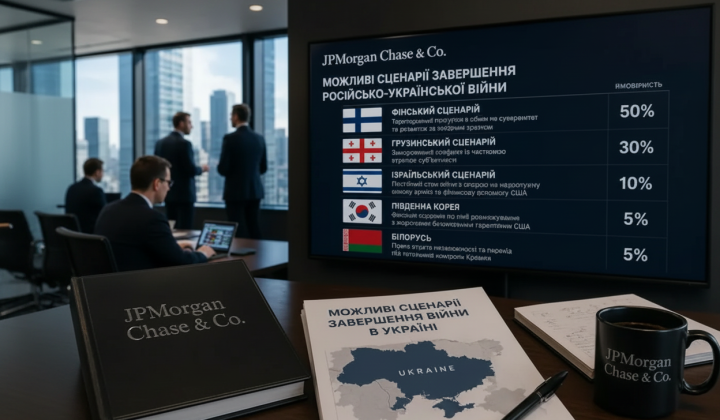
According to Главком: A new analysis from U.S. financial giant JPMorgan Chase outlines several potential pathways to ending the Russia-Ukraine war. According to the firm's experts, the most likely scenario-carrying a 50% probability-is the so-called "Finnish model." Under this framework, Ukraine would make territorial concessions in exchange for retaining its sovereignty and pursuing Western-style development.
Beyond the Finnish scenario, the report identifies four other possible outcomes:
- Georgian model (30% probability): A frozen conflict where Ukraine loses part of its agency and territorial control.
- Israeli model (10% probability): A perpetual state of war, relying on a strong domestic military and U.S. financial aid, but without formal alliance membership.
- South Korean model (5% probability): Borders are fixed along the current front line, backed by robust U.S. security guarantees.
- Belarusian model (5% probability): The worst-case scenario, involving a complete loss of independence and absorption under Kremlin control.
The report also notes that Russian President Vladimir Putin has signed a decree simplifying the process for residents of the breakaway region of Transnistria to obtain Russian citizenship-a move with potentially major implications for regional stability. While the conflict's endgame could take many forms, JPMorgan Chase analysts emphasize that the Finnish model remains the most realistic path, hinging on mutual compromise.
The Complexity of Ukraine's Situation
The JPMorgan Chase report underscores the complexity of Ukraine's current predicament and the far-reaching consequences of each potential resolution. The Finnish model, centered on compromise, may be viewed as a pragmatic route to achieving regional stability. At the same time, Russian actions-such as the citizenship decree for Transnistria-signal a continuation of aggressive policies that could hinder peace efforts. These developments present additional challenges for the international community as it seeks ways to support Ukraine and uphold its territorial integrity.
As the situation evolves, the Kremlin is reportedly crafting its own strategy to conclude the conflict, which also involves territorial adjustments. This development highlights the intricate dynamics at play in negotiations, as various models for peace are being considered, each with distinct implications for Ukraine's sovereignty and regional stability.

Read also