Cow Manure Transformed into Aviation Fuel with Over 98% Efficiency

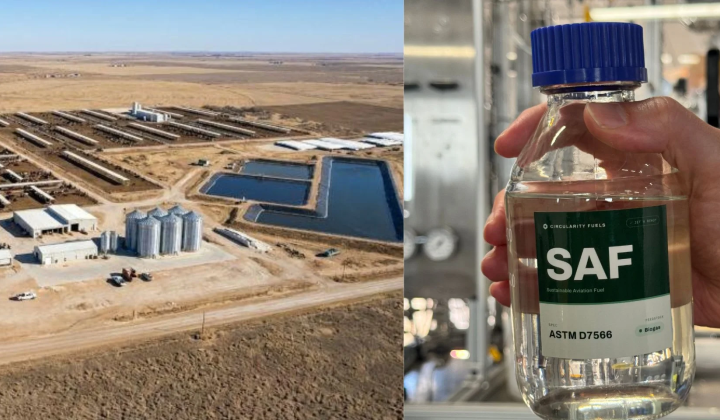
Circularity Fuels Pilot Project Achieves Breakthrough
According to НВ — Техно: June 17, 08:30
A California-based company, Circularity Fuels, has successfully completed a pilot project that converts biogas from cow manure into aviation fuel. The initiative took place on a dairy farm near the city of Madera, home to more than 5,000 head of cattle. The company's proprietary technology produces fuel that meets international ASTM standards for commercial aviation, without the need for prior gas purification.
The six-month pilot ran continuously on real-world feedstock. The raw biogas used for fuel production consisted of roughly 65% methane and 35% carbon dioxide. As a result, methane conversion efficiency exceeded 98%, while carbon dioxide conversion topped 90%. The finished fuel can be blended with conventional jet fuel in proportions of up to 50%.
Technology and Future Prospects
The system deployed in the project includes two modular reactors: an electrified bireforming reactor and a compact Fischer-Tropsch reactor. Circularity Fuels reports that commercial-scale units producing aviation fuel will cost less than $100,000 per barrel of daily capacity. Company representative Steven Beaton noted,
“The hard part in this industry has never been designing a theoretical plant. The hard part was proving you can do it continuously, on real biogas, at a cost that makes sense.”
This pilot project by Circularity Fuels not only demonstrates progress in turning waste into valuable resources but also reflects a growing commitment to sustainable technologies in aviation. With many countries pledging to reduce greenhouse gas emissions, such innovations could become crucial for ensuring the environmental sustainability of the aviation sector in the future. The successful implementation of this technology may encourage similar initiatives in other regions seeking to lower their environmental impact.
As the aviation industry seeks innovative solutions to reduce its carbon footprint, the recent pilot project by Circularity Fuels stands out as a promising development. Similar initiatives, such as the first U.S. facility converting CO2 into synthetic jet fuel, highlight the growing trend of utilizing alternative feedstocks to produce sustainable aviation fuels. These advancements could play a significant role in shaping the future of eco-friendly air travel.

Read also