NASA Releases a Time-Lapse of the Psyche Probe's Flyby Past Mars

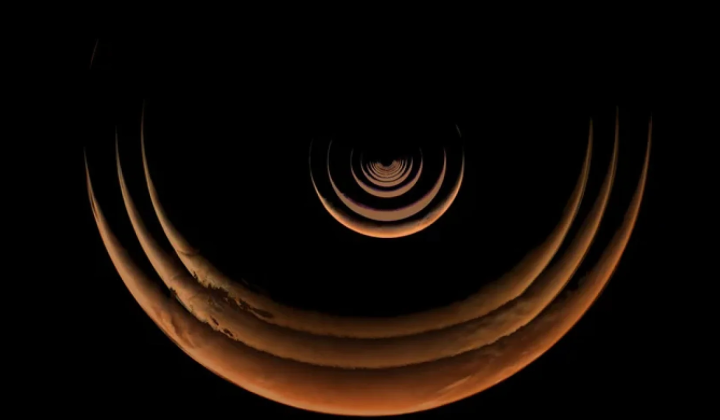
Mars Captured by the Psyche Spacecraft
According to НВ — Техно: In May, the Psyche spacecraft snapped thousands of images of Mars during its close approach to the Red Planet. NASA has now compiled these into a time-lapse video, showcasing the planet's surface and its southern polar region. The flyby occurred between May 2 and May 15, with the probe reaching its closest point to Mars on May 15. This maneuver was used for a gravity assist, allowing Psyche to adjust its flight path and gain speed without burning extra fuel.
Observing Mars' Moons
During the encounter, the probe also captured images of Mars' moons, Phobos and Deimos. The spacecraft relied on a multispectral camera operated by Jim Bell of Arizona State University. Bell noted that
“the instrument performed its job flawlessly and delivered rare views of the Red Planet.”
He further emphasized that
“the flyby allowed us to test the camera's accuracy, its sensitivity to stray light, and to capture Mars' moons from a great distance.”
Having completed its Mars flyby, the Psyche spacecraft will now continue its journey toward its namesake asteroid, where it will use similar techniques to search for any small moons that might orbit it. Psyche is expected to reach the asteroid Psyche in 2029.
This mission marks a significant step in exploring both Mars and the potential resources that may exist on the asteroid Psyche. The images obtained during the flyby not only deepen our understanding of the Red Planet but could also lay the groundwork for future research and missions. The successful gravity assist maneuver also validates new technologies that could be applied in upcoming space exploration efforts.
As the Psyche spacecraft continues its mission towards the asteroid Psyche, it's worth noting that in 2029, a different celestial body will make headlines when the Apophis asteroid passes remarkably close to Earth. This event presents another opportunity for scientists to study near-Earth objects and their potential impact on our planet, further highlighting the importance of ongoing space exploration.

Read also