165 Corruption-Prone Provisions Found in Ukrainian Laws and Decrees by Anti-Corruption Agency

Tracking Corruption Risks in 2026
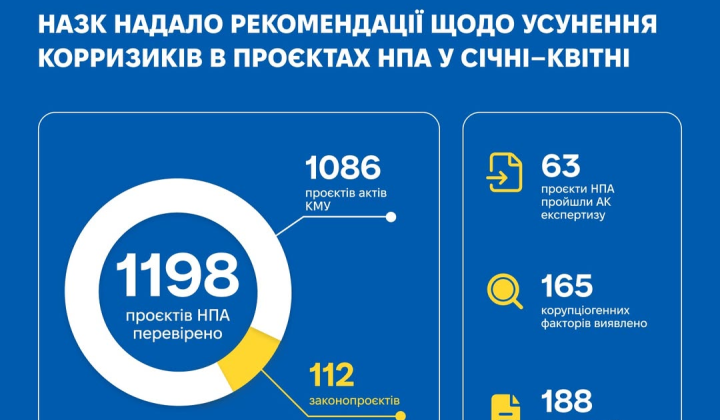
According to НАЗК: In the first four months of 2026, Ukraine's National Agency for the Prevention of Corruption (NAZK) reviewed 1,198 draft regulatory acts and carried out anti-corruption assessments on 63 of them. These efforts uncovered 165 factors that could facilitate corruption and led to 188 recommendations for their removal. According to NAZK, nearly all of these recommendations-close to 100%-were adopted by the drafters of the proposed legislation.
The agency also analyzed Draft Law No. 12439, which focuses on protecting businesses, following a request from Transparency International Ukraine. In a draft decree concerning the sale of seized assets managed by the National Asset Recovery and Management Agency (ARMA), NAZK identified 7 corruption-prone elements and issued 9 recommendations to address these risks.
Recommendations Adopted and Key Risks Identified
For instance, Ukraine's Ministry of Defense took NAZK's feedback into account and removed a corruption-prone factor from a draft decree on centralized defense procurement. Similarly, the Ministry of Health fully incorporated NAZK's recommendations into a revised draft decree on selecting members of the National Mental Health Commission.
Among the corruption-prone factors discovered were:
- risks of excessive discretion for law enforcement agencies;
- opportunities to evade criminal liability through official clarifications from authorities;
- opaque procedures for entering information into the Unified Register of Pre-Trial Investigations;
- lack of mechanisms to verify the source of funds for potential buyers;
- vague criteria for evaluating candidates;
- non-transparent operations of selection committees.
NAZK's work in 2026 is therefore focused on spotting and eliminating corruption risks in legislation, a crucial step in Ukraine's fight against corruption.
The monitoring and assessments conducted by NAZK highlight the government's active push for greater transparency and the prevention of corruption in lawmaking. The fact that various ministries are heeding the agency's advice signals progress in anti-corruption efforts and a willingness among state bodies to cooperate. This could improve Ukraine's investment climate, as reducing corruption risks makes the country more attractive to investors.
In addition to its ongoing legislative reviews, NAZK's efforts also extend to monitoring financial transparency among public officials. Recent findings revealed over UAH 1.2 billion in discrepancies related to false declarations. This highlights the persistent challenges in Ukraine's anti-corruption landscape and underscores the importance of vigilance in both legislative and financial accountability. For more details on the implications of these findings, see our report on false declaration data.

Read also