China Unveils New Drone Resembling Boeing MQ-25 Stingray and Advances Supersonic TMS-10 Jet for 2026

Emergence of a New Chinese Drone
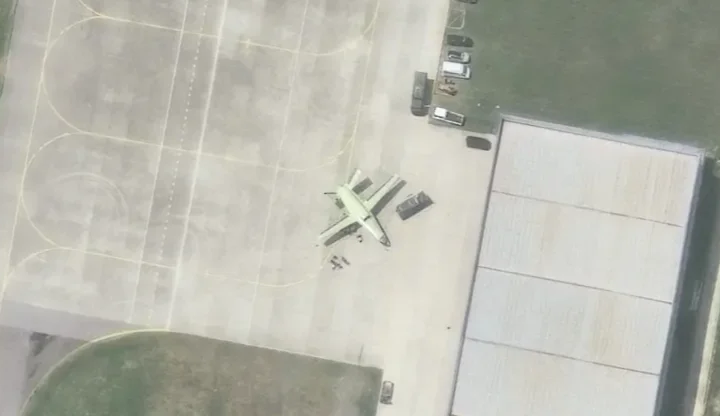
According to НВ — Техно: On November 23, satellite imagery captured at Pucheng Neifu Airport in Shaanxi Province revealed a newly developed Chinese drone bearing a striking resemblance to the American Boeing MQ-25 Stingray. This drone features a wingspan of roughly 20 meters and measures about 15 meters in length. Although it appears capable of multiple roles such as aerial refueling, surveillance, and reconnaissance, no official statements have confirmed its intended operational use.
Design Comparison with Boeing MQ-25 Stingray
The Boeing MQ-25 Stingray, designed primarily as a carrier-based aerial refueling platform for the U.S. Navy, has a wingspan close to 22.9 meters and a length near 15.5 meters. In contrast, the Chinese drone sports a conical nose, differing from the MQ-25's flattened front, and features a dorsal air intake that seems split into two channels. Despite these similarities, there is currently no evidence suggesting the Chinese drone is meant for in-flight refueling or aircraft carrier operations.
Meanwhile, China is making significant progress on the supersonic passenger jet TMS-10, developed by the Tianmushan Laboratory with support from Beihang University. The final assembly phase is underway, with flight testing expected by the end of 2026. The laboratory has already completed wind tunnel tests of the TMS-10 and is actively designing flight control systems and manufacturing the airframe.
The discovery of this new drone highlights China's growing ambitions in unmanned aerial technology and military aviation, factors that could influence regional security dynamics and the global balance of power. Additionally, the push to develop the TMS-10 supersonic airliner underscores China's intent to become a leader in civil aviation innovation, particularly in supersonic travel, marking an important advancement in the country’s aerospace infrastructure and technological capabilities.
As China's drone capabilities continue to evolve, the recent advancements of the GJ-11 drone in combat scenarios further underscore the nation's ambitions in military aviation. This development, alongside the TMS-10 supersonic jet's progress, highlights the strategic importance of these technologies in shaping regional security and competitiveness in the aerospace sector.

Read also