The holiday of European solidarity ends: who will pay for Europe's guns
In Brussels, the moment has come when strategic autonomy meets accounting. Germany, the Netherlands, Sweden, Denmark, Austria, and Finland, which together account for about 40% of contributions to the EU budget, demand to reduce the financial framework proposed by the European Commission for 2028-2034 by "several hundred billion euros." We are talking about a project of nearly €2 trillion. The six warn: without a serious reduction, they are not ready to support it.
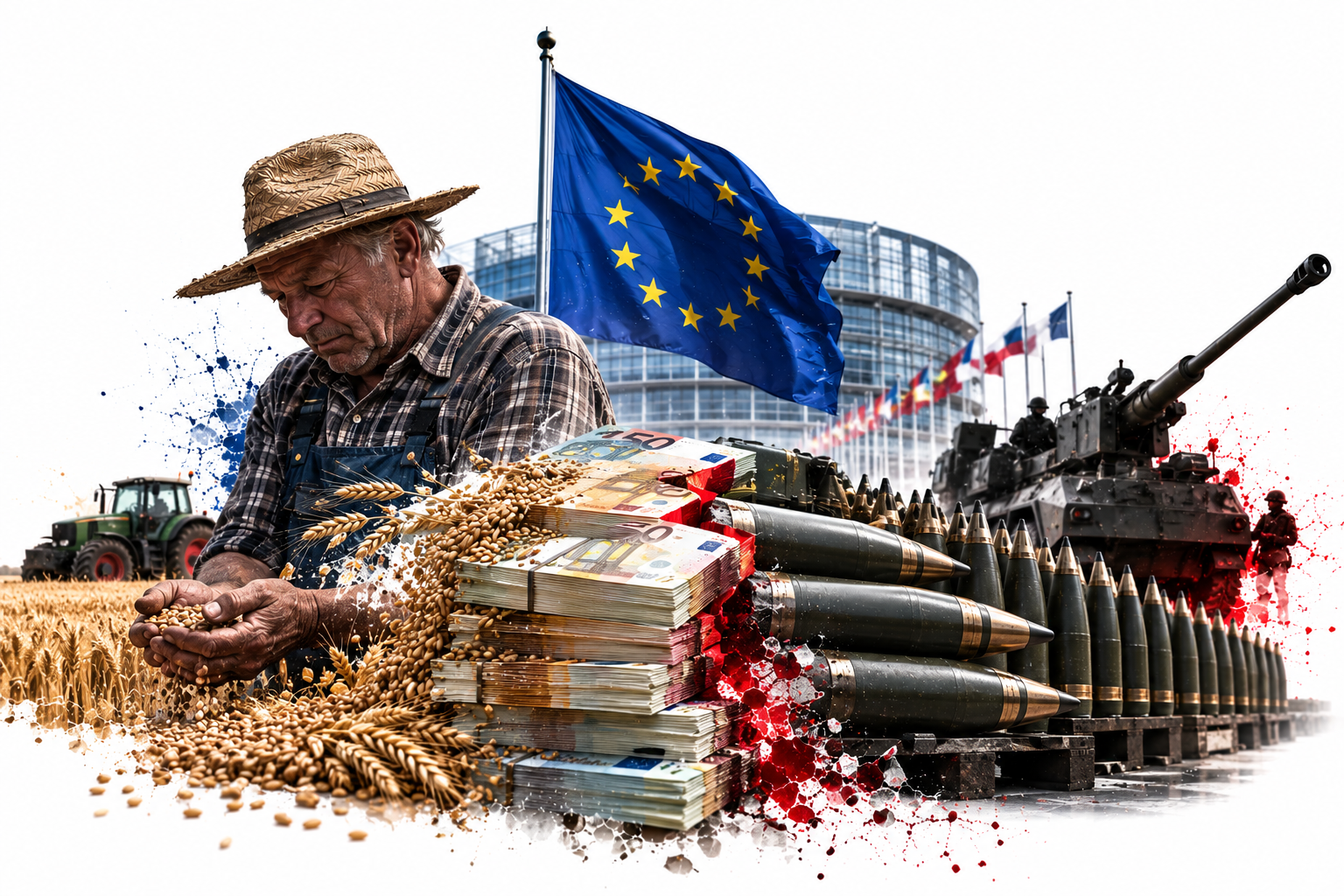
Six major EU donors demand to cut the proposed budget of the Union for 2028-2034 by hundreds of billions of euros. At the same time, Europe wants to quintuple joint funding for defense and space. The arithmetic is uncomfortable: if Brussels does not increase revenue and does not resort to new joint debts, new guns will have to be paid for with old money. Thus, the dispute over European rearmament is gradually turning into a dispute about farmers, regions, and who, in general, should pay for the new Europe.
This is not quite an ultimatum in the style of "take money from farmers and give it to gun manufacturers." The official common position of the six states is phrased more diplomatically: the budget needs to be modernized, and the priorities should be security and defense, competitiveness, migration, and sovereignty. However, the economic content of the dispute remains almost unchanged. If the overall budget is cut, and the share of new priorities increased, savings will have to be made somewhere in the old.
And this is where the most interesting things begin.
Guns versus cows
For decades, the European Union budget has primarily been a machine for redistribution. The common agricultural policy supported farmers, cohesion funds built roads, bridges, railways, and sewage systems in less prosperous regions, while wealthier countries in the North and West paid more into the common pot than they received back.
To call this "European socialism" is spectacular but economically inaccurate. It is rather the political price of the single market: wealthier economies gain access to a huge internal market, and the budget helps reduce the gap between its center and periphery.
Now, a new article - defense - has been added to the old contract.
The European Commission proposes to allocate €131 billion for defense, security, and space in the next seven-year budget - about quintuple the current financial framework. Funding for military mobility is planned to increase about tenfold. At the same time, about €865 billion is foreseen for national and regional partnership plans, which will combine a significant part of traditional agricultural and cohesion programs.
Thus, Europe faces a rather straightforward budgetary task.
More money for defense. More money for competitiveness. More money for technology. More money for borders. But at the same time, the biggest donors want a smaller overall bill.
Somewhere, there must be a minus.
€300 billion that farmers already see as theirs
The most obvious place for such a minus is traditional budget items. According to the Commission's proposal, €300 billion must be guaranteed to be reserved for income support for farmers and fishermen. Protective mechanisms are also foreseen for less developed regions, so they do not receive less than the current cohesion envelope.
That is why the thesis that Brussels has already decided to "take money from farmers" oversells the situation. Nothing has been decided yet.
But the direction of the conflict is real.
Financial Times reports that the six donors want to spend less on traditional areas, including agriculture and regional development, and more on defense and innovation. Moreover, this is not a discussion about a few billion. It is about hundreds of billions of euros in difference between the European Commission's vision and the position of the frugal states.
In peaceful times, such a dispute would have been another round of Brussels trading. Now it has gained a military dimension.
The European farmer increasingly competes for each budget euro not with other social programs, but with rockets, satellites, munitions factories, and military railways.
The German paradox
The most interesting position belongs to Berlin.
Chancellor Friedrich Merz called the proposed budget increase of about 60% unrealistic and urged to cut spending by hundreds of billions of euros. Germany also opposes a new big round of joint European borrowing. At the same time, Berlin wants Europe to spend more on defense and competitiveness.
There is no mathematical contradiction in this. There is a political one.
If the overall budget is not increased, no major new debt is created, and defense spending is sharply increased at the same time, one obvious tool remains: redistribution.
Not necessarily "farmers instead of tanks" in the literal sense. But the logic is exactly this: every additional euro for the new defense fund must either come from taxpayers, or be borrowed, or disappear from some other budget item.
The fourth way of accounting has not yet been invented.
The trap of unanimity
And then the best part of European budget architecture begins.
To adopt a multiannual financial framework, unanimity of all 27 member states in the EU Council is required, followed by the agreement of the European Parliament.
This means Germany and its five allies can block an excessively large budget.
And states that rely heavily on agricultural or cohesion payments can block an excessively small one.
This is where the accounting problem transforms into a political one.
For the Netherlands, an additional billion to the EU budget is primarily an additional contribution. For a less wealthy state in Central or Southern Europe, that same billion may mean roads, regional programs, or support for farmers.
Thus, the phrase "the budget needs to be modernized" sounds great until a table with specific countries and specific amounts appears.
The European compromise traditionally emerges precisely in this table.
But money in Europe has not run out
The thesis that Europe "has no more free money" also needs correction.
The EU is one of the largest economies in the world. The proposed seven-year budget of nearly €2 trillion constitutes only about 1.26% of the total gross national income of the Union. Theoretically, Europe can finance significantly more.
The problem is not in the literal absence of money.
The problem is who is willing to give it.
The European Commission proposes new own revenues for the EU. Some states are ready to discuss new joint debt. Germany and its allies want primarily reductions and redistribution of existing expenditures. Other governments do not want to lose agricultural and regional programs.
These are three different ways to pay the same bill.
That is why comparing the EU budget with a national budget is also dangerous. Brussels cannot simply act like Washington, issue a huge volume of federal debt, and allocate money at the discretion of a central government. The European budget remains the result of negotiations among 27 national states, each with its own parliament, voters, and budget.
Europe lacks not capital. It lacks agreement on whose capital it is.
War economy under peaceful rules
This dispute wonderfully continues the main problem of War 4.0.
Europe wants to rearm. For this, ammunition factories, air defense, missiles, satellites, drones, military mobility, and new technologies are needed. But the defense industry does not require a one-time check but guaranteed orders for decades.
And just at the moment when manufacturers are offered to scale up, governments dispute who will pay for the scaling.
This does not mean that defense money will automatically go only to German or Scandinavian concerns. The new European Competitiveness Fund is conceived as a pan-European mechanism, and defense production is distributed among many states. The thesis that the North wants to take subsidies from the East to give contracts to its arms manufacturers, without further evidence, would be an attribution of motives.
However, the political conflict does not disappear from this.
Each ammunition factory has an alternative cost. Every new defense program competes with infrastructure, agricultural payments, climate projects, or higher contributions from national governments.
The European military economy is built within a system created for a peaceful Europe.
The Irish bill
Now this knot must be unraveled by Ireland, which will hold the EU Council presidency in the second half of 2026. The European Council tasked the Irish presidency with advancing negotiations to the summit on October 15, and a political agreement is sought by the end of the year so that the necessary legislation can be adopted during 2027 and the new budget can be launched from January 2028.
To call a compromise impossible would be premature. The EU specializes precisely in agreements that seem impossible a few weeks before the summit. The most likely mechanics of any compromise will be a complex mixture of cuts, guarantees for specific sectors, new revenues, transitional periods, and special funds.
But this time the dispute is significantly more fundamental.
Europe is trying to remain simultaneously an agricultural union, a fund for regional leveling, a technological superpower, a climate investor, and a new military force. The six major donors reminded Brussels of an unpleasant truth: all five roles come at a cost.
European solidarity has not ended. It has simply entered its most expensive phase - when solidarity must be not only declared but paid for.
The question of the new EU budget is no longer whether Europe needs guns. The question is who will agree to receive less butter for their sake.

Read also