Technical Analysis: Reading Price Channels

Every professional trader will tell you that the ability to correctly identify the trend and build price channels is one of the most necessary skills for achieving success. Some trading strategies are based on trading within the channel or when it breaks out.
In this article, we will examine in detail: the main concepts of technical analysis, what a trend line is, types of price channels, how to interpret them and make trading decisions.
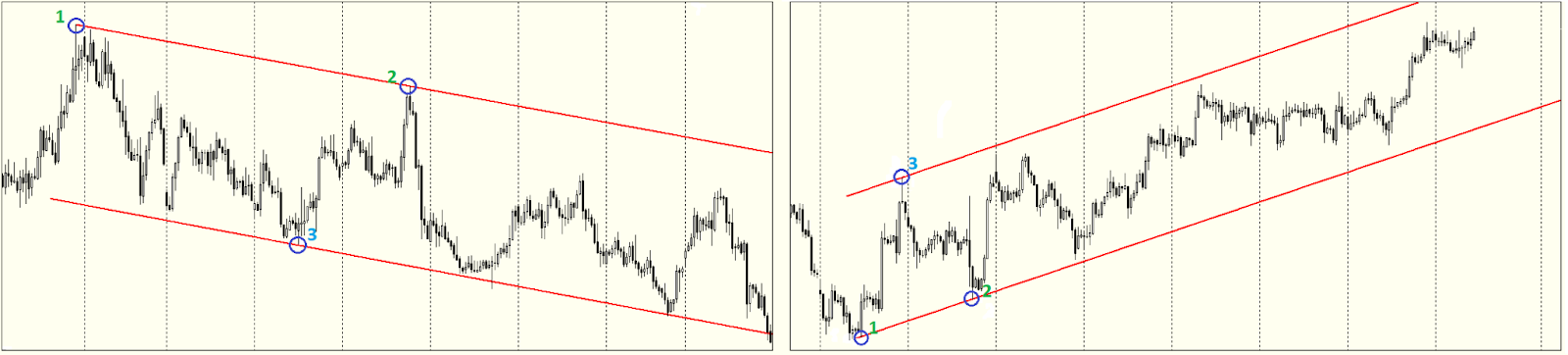
Price Channel
Source: https://trading.biz
Basics of Technical Analysis
The main tool of every successful trader is technical analysis (TA). This is a method of predicting the further price movement of assets. It is based on studying patterns and historical data regarding trading volumes and price. The method is used in all financial markets: Forex, stocks, bonds, resources, metals, cryptocurrencies, etc.
In trading, various instruments for analysis are used:
- Indicators (moving averages MA, stochastic, oscillator, MACD, RSI, Bollinger bands, etc.).
- Price channels.
- Support and resistance lines.
- Trading volumes.
- Graphic and candlestick patterns.
- Various timeframes (1 min, 5 min, 1 hour, 4 hours, 1 day, 1 week, 1 month, etc.).
Technical analysis is often performed in parallel with fundamental analysis, which significantly increases the effectiveness of trading strategies. The use of TA allows for quick analysis of market situations, finding entry and exit points, and is suitable for all financial markets and assets.
What are Price Channels and Their Significance?
Price channels refer to graphical patterns that indicate the continuation of a trend in TA. They are constructed using two parallel lines: one along the lows (support), the other along the highs (resistance).
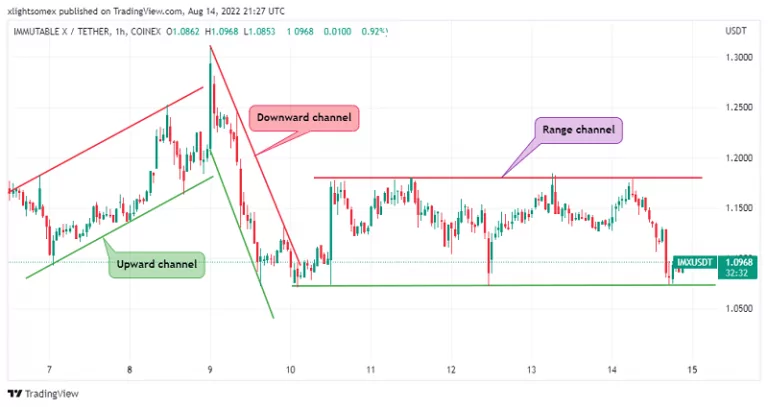
For some time, the price moves from the lower boundary to the upper, bouncing like a tennis ball. Several strategies are employed for this pattern: trading within the channel or opening positions upon breaking through resistance or support, and entering a position on the retest of the broken line.
Source: https://trading.biz
There are 3 main types of channels:
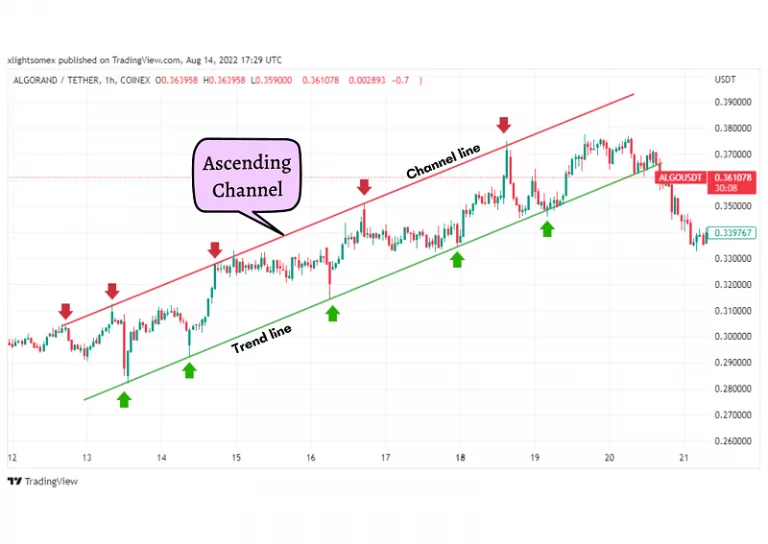
- Ascending (bullish) – directed upwards. Its formation occurs through the construction of a trend line. The beginning starts from the lowest point of the maximum price of the asset, and the upper line is constructed parallel from the maximums.
- Descending (bearish) – directed downwards. The trending is determined from the upper point of the maximum price of the asset, and the lower boundary is constructed parallel along the minimum points of the price.
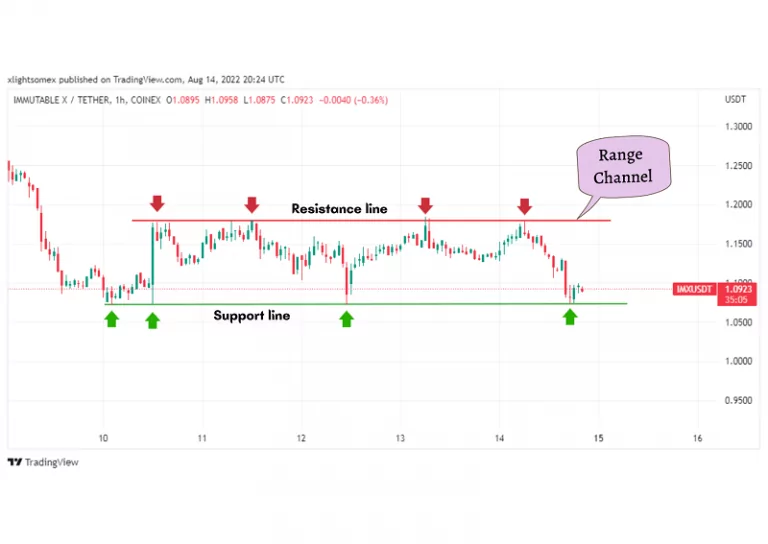
- Horizontal (flat) – has no incline. It is interpreted as a flat or accumulation period. It often occurs when neither sellers nor buyers have an advantage in the market.
Correct construction of price channels allows for profit-making from asset trading in any conditions: during bullish or bearish cycles, and also in prolonged flat periods. Thanks to the boundaries of the range, one can find entry points and exit positions, as well as levels for setting stops and choosing the most appropriate trading option for the situation.
How to Interpret Price Channels?
Source: https://trading.biz
To correctly interpret and build price channels, certain knowledge and skills are required:
- Key components of the range. To form it, it is necessary to correctly identify the trend, support, and resistance lines.
- Theoretical foundations. To create a correct range, it is necessary to build two parallel lines along the minimums and maximums, which will be the boundaries of price movement.
- Interpretation. If the price constantly remains within the channel, it indicates a period of consolidation or trading within the range. If the asset's indicators exit the boundary of one of the lines, it may indicate a trend change.
- Practical application. When value indicators move for some time within clear boundaries, traders successfully trade this type of movement. An order for a short or long position is opened from one boundary and closed upon reaching the other. A stop in this case is set at the levels of resistance or support. Another trading option: the asset is purchased after breaking the channel boundary and confirming the trend change.
Main types of channels:
- Help determine the current trend.
- Allow for clear identification of support and resistance. The upper and lower lines of the channel can serve as resistance and support zones, respectively.
- Used to open positions depending on the strategy, help find entry and exit points.
The ability to correctly interpret the formation of price ranges requires careful analysis and the use of additional indicators for confirmation. It is also important to consider fundamental market analysis, which can greatly affect price fluctuations.
Trading Strategies Based on Price Channels
The pattern of price ranges is constantly used by traders for analysis and trading.
There are several key channel strategies:
- Trading in an ascending channel
This option involves entering a long position upon reaching the asset's price indicators at the lower boundary (support) and fixing - near the upper boundary.
2. Trading in a descending range
For this option, a short position is entered near the upper boundary, and fixing - near the lower boundary.
3. Trading on breakout
This involves opening positions only after the price indicators move beyond the upper or lower boundary. This option suggests a potential trend change; however, it should be used with indicators and breakout confirmation signals.
4. False breakout
This is used when the price moves outside the channel but then returns. This is considered a false breakout and can signal an opening position in the opposite direction.
All strategies with price ranges should combine data from technical indicators and other analytical methods to confirm signals and reduce risks.
Errors in Analyzing Price Channels
Source: https://trading.biz
Typical mistakes that traders make when working with channels:
- Incorrect determination of channel boundaries. Mistakes in building resistance and support lines can lead to incorrect entry and exit points and trading decisions.
- Ignoring context and important news. Traders often overlook important events, decisions, or news that significantly affect financial markets. This can lead to losses since they do not consider the full volume of information.
- Ignoring risks. Underestimating the situation, lack of stops, and untimely reaction to a trend change can lead to significant financial losses.
- Using only price channels in work. If analysis data is not backed by other methods, there are quite high risks of making mistakes.
It is important always to carefully analyze the market before making decisions and understand that there is no universal strategy. Conditions and markets are constantly changing; for a trader, it is important to remain flexible and quickly adapt to new conditions.
Practical Advice and Tools for Traders
In their activities, traders use various methods for making trading decisions. The basic foundation for every professional includes fundamental and technical analysis tools: indicators, oscillators, Fibonacci levels, sales and purchase volumes, support and resistance levels, trend lines, moving averages, as well as monitoring of economic and political news that can affect financial markets, etc.
- Continuously work on self-education and improvement of your skills. Even experienced traders always have something to learn. The market is constantly changing, new analysis methods, strategies, trading bots, artificial intelligence-based systems, etc., are emerging.
- Create your own strategy that suits you. It is important to have a clear plan and stick to it. It should include various market analysis methods depending on your trading style, financial goals, and risk profile.
- Apply a comprehensive approach to analysis. It is important to consider not only indicator data and other mathematical tools but also pay attention to the informational background, economic and political events.
- Choose reliable platforms, exchanges, and brokers for trading. This affects the variety of analysis tools, liquidity level, commissions, and the resolution of issues with customer support.
- Use different services for additional analysis. For example, Coinmarketcap, CoinGecko, Tradingview, Crunchbase, Cryptorank, CoinMarketCal, Coindar, LunarCrush, TokenUnlocks, CryptoMiso, etc.
- Pay careful attention to your risks. Remember: the main rule is to preserve your invested money, and only then to increase it. Choose more stable assets with low volatility and pre-decide what percentage of your deposit is allocated to each transaction. If you choose to buy a high-risk asset, you must understand that it can not only bring high profits but also significant financial losses.
- Do not use high leverage in trading. Even when you are confident in the direction of the asset's movement, unforeseen events can occur, and then your position will result in very large losses or even the loss of your entire deposit.
- Work on controlling emotions and study the psychology of the market. Without the ability to remain calm in any situation, it is impossible to achieve success. Understanding market processes and major psychological principles provides a significant advantage and understanding of market processes.
Remember that success in trading requires time, patience, experience, and constant learning. Always consider the risks and never invest more than you are willing to lose.