Salt Clouds Detected on Exoplanet 60 Light-Years Away by James Webb Space Telescope

Discovery of Exoplanet GJ504b
According to НВ — Техно: On June 29 at 2:00 PM, researchers announced that the atmosphere of exoplanet GJ504b contains salt clouds, which account for its unusual spectral features. This breakthrough was made possible using the James Webb Space Telescope. First identified in 2013, GJ504b lies less than 60 light-years from Earth. The planet orbits a Sun-like star at a distance more than 40 times greater than the separation between Earth and our Sun.
Characteristics and Significance of GJ504b
GJ504b is the coldest companion ever detected by ground-based telescopes. It is roughly 10% smaller than Jupiter but has a mass nearly 25 times greater. Its surface temperature hovers around 290 degrees Celsius, and it is estimated to be between 2.5 and 4.5 billion years old. The team tested three cloud models, and salt-based clouds proved the best fit for the data, according to Anish Baburaj.
GJ504b’s atmosphere contains:
- water vapor
- carbon monoxide
- methane
- ammonia
- hydrogen sulfide
Scientists also found that the atmosphere may have a higher concentration of heavy elements-such as carbon, oxygen, and sulfur-than the star it orbits. This marks the first time salt clouds have been identified as the key explanation for an object’s spectrum.
“After examining the spectrum, the researchers immediately realized they were dealing with something unusual,” added Anish Baburaj.
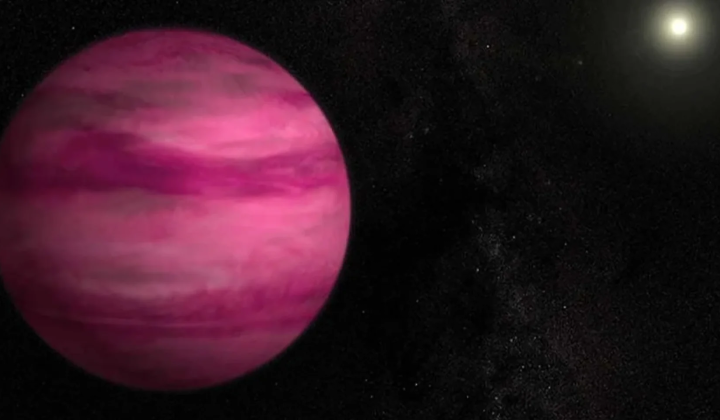
An illustration of the hazy, pink-tinged gas giant GJ504b (Image: NASA/Goddard Space Flight Center) continues to highlight the uniqueness of this finding. Such studies could deepen our understanding of atmospheric processes on exoplanets and how they evolve across the cosmos.
The detection of salt clouds in GJ504b’s atmosphere marks a major step in exoplanet research. It provides clearer insights into the composition and dynamics of atmospheres on similar worlds, which could have important implications for the search for habitable conditions on other planets and for understanding planetary system evolution on a universal scale. The capabilities of the James Webb Space Telescope are opening new frontiers in astronomy, paving the way for further discoveries in this field.
In addition to the groundbreaking discovery of salt clouds on GJ504b, the James Webb Space Telescope has also recently identified a significant temperature spike on another exoplanet. This development sheds light on the diverse atmospheric conditions present in distant worlds. For a deeper understanding of these extreme temperature variations and their implications for exoplanet research, explore the details of the recent temperature surge detected on an exoplanet.

Read also