Luxurious Roman Villa Unearthed in Devon Features One-of-a-Kind Mosaic

Roman Villa Discovery in Devon
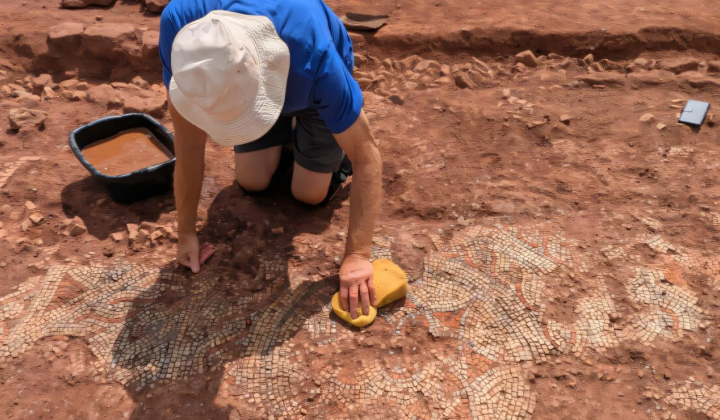
According to НВ — Техно: A 4th-century Roman villa has been uncovered by archaeologists in Devon, western England, boasting a striking polychrome mosaic, a bathhouse with two pools, and numerous artifacts pointing to wealthy inhabitants. The excavation, conducted between the villages of Halberton and Sampford Peverell, spanned two months.
The polychrome mosaic, covering 12 square meters, is crafted from thousands of red, white, and dark blue-gray stone cubes measuring 12 millimeters each. This piece stands as the westernmost known mosaic found in a Roman villa in Britain. Project lead Dr. Susan Greaney from the University of Exeter’s Department of Archaeology and History remarked:
“We knew this villa and its surrounding work areas were a key site for understanding the Romanization of Devon.”
She added that 'from day one, it offered us a wealth of intriguing, and sometimes astonishing, finds in addition to this impressive polychrome mosaic'.
Artifacts and Their Significance
Beyond the mosaic, archaeologists uncovered a bathhouse with at least two plunge pools, highlighting the villa’s high level of comfort. The dig also yielded valuable artifacts, including:
- an intaglio depicting the goddess Victoria,
- a copper-alloy bracelet,
- a silver-plated spoon,
- a handled cup for serving drinks,
- a natural flint piece, likely used as a palette.
Bill Horner, county archaeologist and historic environment manager at Devon County Council, stated:
“The polychrome mosaic is the westernmost example found in a villa in Roman Britain. This, along with other discovered attributes of Roman civilization and evidence of prosperity, shows how even this remote part of the province was integrated into the Roman Empire.”
Plans are in place to display the mosaic at the Tiverton Museum of Mid-Devon Life, making it accessible to the public. The excavation underscores the importance of archaeological research in understanding the region’s history and cultural heritage. A mention of the dig also appeared in March 2026 in the Swiss canton of Thurgau.
This Roman villa discovery in Devon is significant for archaeology, as it not only expands knowledge of Roman presence in Britain but also highlights the living standards and cultural practices in this part of the empire. Findings like the mosaic and artifacts provide crucial insights into the social structure and daily lives of the region’s inhabitants. Displaying the mosaic at the museum could be a key step in promoting history and archaeology to a broader audience.
As researchers continue to uncover remarkable Roman artifacts, a recent discovery in Turkey has revealed an ancient mosaic dating back to the 4th to 6th centuries. This find not only parallels the stunning polychrome mosaic found in Devon but also highlights the extensive cultural exchanges within the Roman Empire. For more insights into this significant archaeological discovery, explore the details in our coverage of the ancient mosaic unearthed in Turkey.

Read also