Four Million Drones Produced by Ukraine in a Year: Five Shifts in Modern Warfare and NATO’s Lack of Readiness

Tech Competition in the Russia-Ukraine War
According to ХВИЛЯ: Andriy Zagorodnyuk, a former Ukrainian defense minister, examines technological rivalry in the Russia-Ukraine conflict in a piece for the Carnegie Endowment for International Peace. He identifies five transformations reshaping contemporary combat:
- affordable precision mass,
- airspace fragmentation,
- increased difficulty of maneuvering,
- the central role of network-centric warfare,
- rapid adaptation as a critical military capability.
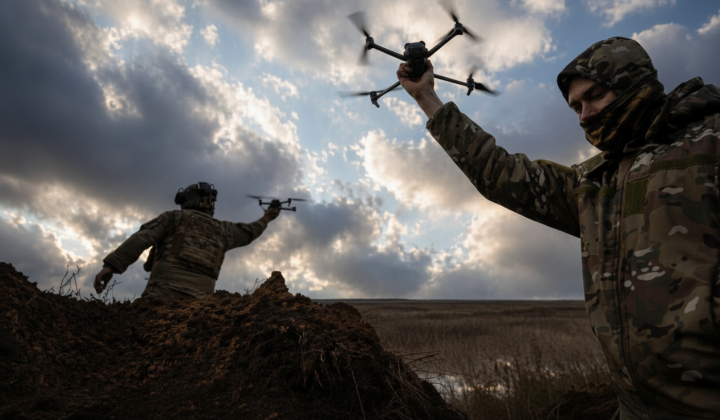
By 2025, Ukraine had manufactured and deployed 4 million drones, which now constitute 20 percent of its military personnel and inflict over 80 percent of enemy casualties.
According to the article, Russia launches roughly a thousand Iranian Shahed drones nightly at Ukrainian targets. In February 2026, Ukraine restricted the use of commercial Starlink communications on long-range drones, reflecting tactical evolution in response to emerging challenges. In September 2025, 19 Russian drones entered Polish airspace, highlighting the issue of airspace fragmentation.
Zagorodnyuk notes that NATO interceptors shot down Russian drones at a cost far exceeding the drones' value. This underscores the economic dimensions of technological warfare.
Additionally, statements from Rheinmetall CEO Armin Papperger in March 2026 emphasize the need for military strategies and technologies to adapt.
The Network-Centric Warfare Concept
Ukraine has implemented network-centric warfare through the Delta platform, which has become a vital tool in countering the aggressor. The United States first formulated the concept of network-centric warfare in the late 1990s, highlighting its lasting relevance in modern military contexts. Regional staff exercises in 2025 revealed a shocking level of NATO unpreparedness, raising doubts about the alliance’s ability to respond swiftly to new threats.
Among emerging technologies, mid-strike drones capable of operating 30 to 300 kilometers from the front line open new possibilities for combat operations. This underscores the importance of advancing unmanned technologies in modern warfare and their role in achieving military successes.
Technological competition in military conflicts, particularly in Ukraine, demonstrates how cutting-edge technologies-especially drones-are transforming the nature of battle. Amid persistent Russian threats and the extensive use of drones, adapting military strategies and technologies has become critical for national security. This development also holds significance for global security, as the technologies employed in Ukraine could influence the strategies of other nations involved in military conflicts.
As the dynamics of drone warfare continue to evolve, understanding how Russia's strategic transformations are reshaping the battlefield becomes increasingly important. These shifts not only impact Ukraine but also have broader implications for global military strategies and preparedness, particularly within NATO. Exploring these developments can provide valuable insights into the future of modern combat.

Read also