400-Million-Year-Old Remains of a Meter-Long Scorpion Discovered in England and Wales

New Species of Giant Scorpion Identified
According to НВ — Техно: On June 8, 2023, researchers announced that fossil remains originally unearthed in England and Wales back in the 1870s have been identified as a new species of giant scorpion, named Praearcturus gigas. This creature lived during the Early Devonian period and measured an impressive length of about 1 meter, with claws reaching roughly 16 centimeters. For context, this period predates the emergence of complex land ecosystems, making the find particularly significant for understanding early life on Earth.
Scientists debated the origin of these fossils for decades. In the 1980s, a theory emerged suggesting they might belong to a scorpion. The lead author of the study, Dr. Richard Howard, curator of fossil arthropods at the Natural History Museum in London, stated:
'People typically imagine giant millipedes or insects from the coal forests of the Carboniferous period. Yet Praearcturus lived at least 50 million years earlier, before trees even existed, when life on land was just beginning to develop.' Dr. Richard Howard
Ecological Insights and Significance of the Discovery
Dr. Howard also emphasized that complex ecosystems had not yet formed on land at that time, so these animals likely spent part of their lives hunting in water. Co-author of the study, Dr. Greg Edgecombe, added that 'during that period, the boundary between land and sea was much less defined than it is today.'
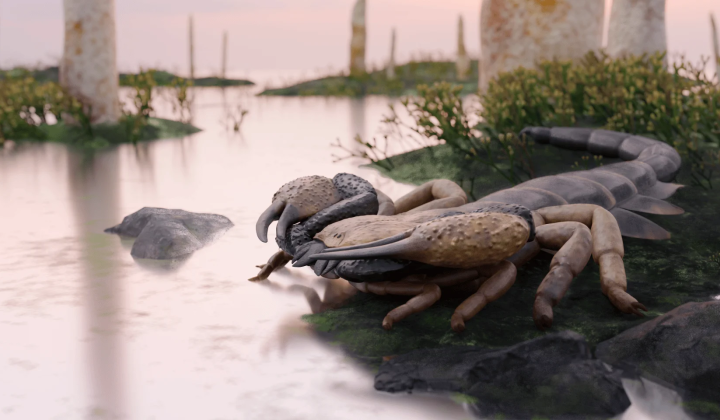
This find allows scientists to deepen their understanding of the evolution of marine and terrestrial ecosystems. A reconstruction of the appearance of the scorpion Praearcturus gigas was featured in publications, including Interesting Engineering magazine, which first covered this research.
The identification of Praearcturus gigas opens new horizons in the study of early invertebrates and their impact on shaping ecosystems. This discovery highlights the importance of fossil remains in understanding evolutionary processes that occurred in prehistoric times, particularly during the early stages of life on Earth.
Further research could shed light on the adaptive strategies of animals during a period when land and sea had no clear boundaries. Thus, studying Praearcturus gigas may represent a crucial step in expanding knowledge about the evolution of life on the planet.
This remarkable discovery of ancient marine life parallels recent findings in paleontology, such as the identification of a new bird species with an extraordinary tail. These revelations not only expand our understanding of evolutionary history but also highlight the diversity of life forms that existed long before modern ecosystems took shape.

Read also