The first trace of a predatory mammal aged 55 million years has been found in Antarctica

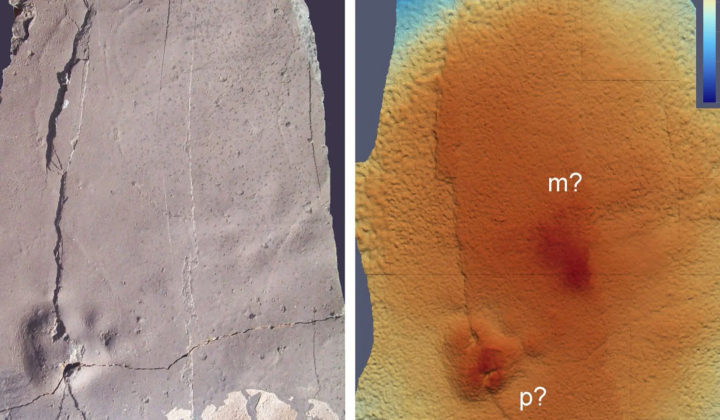
Discovery of a fossilized footprint on King George Island
According to НВ — Техно: A fossilized footprint of a predatory mammal dating back approximately 55 million years, to the Eocene epoch, has been discovered on King George Island in Antarctica. Sample T-373, found in the Fossil Hill formation on the Fields Peninsula, is the first known trace of a fossil mammal in Antarctica. This is the oldest evidence of the existence of a predatory mammal on the continent, discovered in volcanic silt on a remote Antarctic island.
The T-373 imprint is a partial set of footprints from front and hind limbs, roughly the size of a large coin. The sample shows three rounded toe pads on the front paw, a triangular heel pad, and a lack of claw marks. The shape of the footprint indicates a mammal the size of a cat that walked on its toes. Based on the footprint area, researchers estimated the animal weighed around 1.3 kg. The size and shape of the footprint resemble those of sparassodonts - extinct South American carnivorous marsupials similar to weasels that were widespread in Patagonia during the same epoch. Previously, no fossilized bones or teeth of a sparassodont had been found in Antarctica. Researchers believe the footprint is evidence of these animals crossing a land bridge that once connected Antarctica to South America.
New findings and their significance
It was previously thought that the only terrestrial predators in the Eocene forests of Antarctica were small ancestors of modern hawks. The new discovery suggests that mammals also occupied a predatory niche in the Eocene Antarctic ecosystem.
The T-373 trace is the first direct technological evidence of the existence of a terrestrial mammal in Eocene ecosystems of Antarctica.
The complete fossil record of terrestrial mammals from Antarctica had previously been mainly represented by teeth and skeletal remains from Eocene-Oligocene layers of Seymour Island (Marambio). Currently, terrestrial mammals are entirely absent in Antarctica. The article also mentions a dinosaur bone - a vertebra found by a British Antarctic Survey expedition in 1985. This bone from the Santa Marta formation dates back to the late Cretaceous period, around 82 million years ago.
Researchers emphasize that while the earliest traces of mammals or mammal-like reptiles date back to the late Triassic, a significant increase in diversity and abundance of their record occurs closer to the end of the Mesozoic. Following the mass extinction event of the Cretaceous-Paleogene period, the fossil record of terrestrial mammals became significantly more widespread globally, and the T-373 trace is an important step in studying the evolution of these animals in Antarctica.
The discovery of the fossilized footprint T-373 not only expands knowledge about the evolution of mammals in Antarctica but also highlights the importance of the region for studying the history of life on Earth. Fossils indicating the existence of predatory mammals during the Eocene can help scientists better understand the ecological changes that occurred due to climatic and geographical transformations. This discovery, therefore, may have far-reaching implications for paleontology and evolutionary biology.
This finding opens new horizons for studying the evolution of terrestrial predators on the Antarctic continent, which was previously considered devoid of evidence in this aspect. Just as the discovery of a 324-million-year-old insect fossil demonstrated the transition of these creatures to land, new data about T-373 could radically change our understanding of the evolutionary pathways of predatory mammals during the Eocene epoch.

Read also