Lack of Earth’s Magnetic Field Extends Lifespan of Fruit Flies with Mitochondrial Damage but Impairs Their Mobility

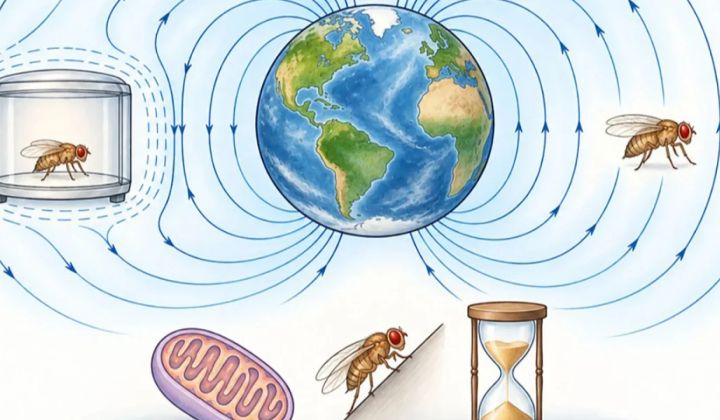
Scientists uncover how removing Earth's magnetic field boosts longevity in damaged cells without drugs
According to НВ — Техно: Published on October 2, 15:14
Image: Fruit flies exposed to Earth's magnetic field (University of Nottingham)
Researchers at the University of Nottingham have discovered that the absence of Earth's magnetic field prolongs the lifespan of fruit flies suffering from mitochondrial defects, although it reduces their physical activity. Conversely, healthy flies showed increased movement and changes in their healthy lifespan when deprived of the magnetic field. This investigation employed ultra-sensitive quantum sensors based on microscopic defects in diamond crystals to explore how the lack of magnetic influence affects mitochondrial function.
Fruit Fly Study Details
The team conducted experiments on two groups of Drosophila fruit flies: one healthy and one with a mutation in the Pink1 gene. This gene is linked to early-onset hereditary Parkinson’s disease in humans and disrupts mitochondrial operation. In flies with damaged mitochondria kept away from the magnetic field, lifespan increased by 20% compared to controls, despite a noticeable decline in their mobility. Healthy flies under the same conditions demonstrated enhanced movement and alterations in their period of healthy living.
The study revealed that absence of the magnetic field modifies mitochondrial oxygen consumption and superoxide release. Professor Lisa Chakrabarti, a lead author, commented:
“Although we live constantly within Earth’s magnetic field, our understanding of how this invisible force affects cellular processes remains surprisingly limited. Our findings suggest magnetism is an integral part of the biological environment life has adapted to over millions of years of evolution.” – Lisa Chakrabarti
The research has been published in the journal Aging.
These insights could significantly advance our comprehension of cellular biology and open new avenues in medical and genetic research. Investigating magnetic field effects on cells presents promising opportunities for developing therapeutic approaches targeting mitochondrial dysfunction-related diseases. Consequently, this study may inspire further experiments that lead to breakthroughs in treating various health conditions.
In addition to the intriguing findings about fruit flies, recent research from China has revealed that certain bacteria can significantly prolong the lifespan of nematodes by over 43%. This discovery highlights the potential of microbial interactions in lifespan extension, providing a fascinating contrast to the effects of magnetic fields on cellular processes. For more insights into this groundbreaking study, you can read about how these bacteria influence longevity here.

Read also