A Ring Beyond Jupiter’s Orbit Became a Cradle for Planetesimal Birth

Unraveling How Planetesimals Took Shape
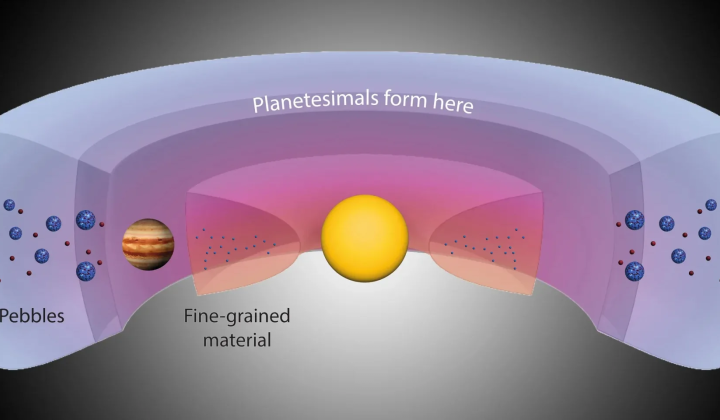
According to НВ — Техно: On May 26, scientists from Germany’s Max Planck Institute for Solar System Research (MPS) released findings identifying a ring-shaped zone of high gas pressure situated just beyond Jupiter’s orbit. This region proved to be a highly effective nursery for planetesimals, where a variety of celestial bodies-including carbonaceous chondrites-formed over a span of roughly two million years. The study focused on the era between two and four million years after the birth of our Solar System.
Around 4.6 billion years ago, the Sun was encircled by a massive disk of gas and dust. As Jupiter took shape, it swept up most of the nearby material, carving a gap in that disk. This, in turn, created a ring of elevated gas pressure immediately behind the planet. Using computer simulations, the researchers determined that within this region, cosmic bodies with diverse compositions emerged over approximately two million years.
Key Findings and Broader Implications
The simulations revealed that such structures can continuously produce different types of bodies over millions of years. Laboratory analyses confirmed that the carbonaceous chondrites linked to these modeled objects indeed originated beyond Jupiter during the studied timeframe. In the first 500,000 years, the amount of loose material trapped in the ring decreased, only to rise again over the next million years. This cycle gave rise to two distinct populations of planetesimals: one composed of fragile matter, and another made of more stable compounds.
Published in The Astrophysical Journal, this research opens up new avenues for studying planetesimal formation and its connection to actual meteorite groups.
This work is significant not only for understanding planetary formation in the early Solar System but also for exploring the evolution of diverse cosmic bodies that may influence how planets develop.
The identified links between planetesimals and meteorites could help astronomers better reconstruct the history of planet and moon formation. This, in turn, would allow for deeper investigation into the conditions under which planetary systems emerged in other parts of the galaxy.

Read also