Calculating Employee Turnover Rate: Formulas, Examples, and 7 Proven Retention Strategies

Understanding Employee Turnover Rate
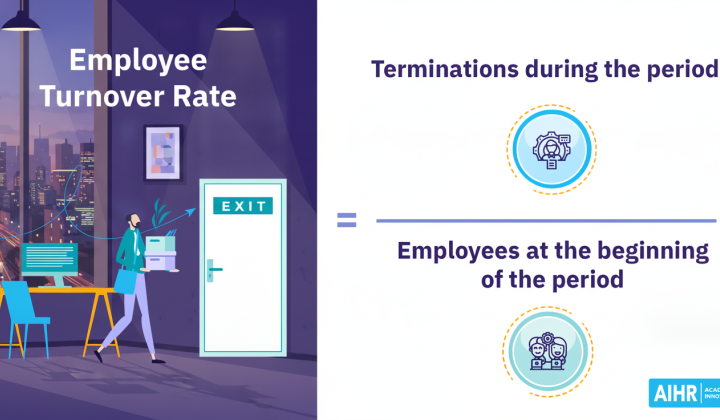
According to AIHR: The employee turnover rate is a crucial metric for organizations, representing the percentage of staff who leave over a specific timeframe. It’s typically calculated using the formula: (Number of separations during the period ÷ Number of employees at the start of the period) × 100. According to ISO 30414 standards, turnover can be assessed across the entire company or broken down by departments, teams, or job roles.
How to Calculate Turnover
Defining who counts as an employee is important. ANSI defines an employee as someone paid during a period that includes the 12th day of the month. When calculating turnover, it’s essential to separate existing employees from new hires. For example, if a company has 100 employees at the beginning of a quarter and 5 leave, the turnover rate is 5%. For annual calculations, the same formula applies: (Number of separations in the year ÷ Number of employees at the start of the year) × 100. So, 10 departures out of 200 employees equals a 5% turnover rate.
Monthly turnover is calculated similarly: (Number of separations during the month ÷ Number of employees at the start of the month) × 100. For instance, if 9 employees leave out of 300 at month-start, the rate is 3%. ANSI also suggests an alternative method using the average number of employees over 12 months, but this can produce distorted results. For example, with 30 separations over three months and an average headcount of 110, turnover would be 27%. However, the standard method might show 30%. Such discrepancies can lead to inflated HR metrics, sometimes even exceeding 200% turnover in small samples.
According to the U.S. Bureau of Labor Statistics, average monthly turnover varies by industry: 2.5% in manufacturing, 3.2% in construction, and 5% in leisure and hospitality. To assist companies in tracking turnover, AIHR offers a free Excel template for these calculations.
Experts recommend seven key strategies to reduce unwanted employee turnover:
- Identifying reasons behind employee departures
- Gathering comprehensive data
- Conducting stay and exit interviews
- Prioritizing retention efforts
- Addressing core workplace issues
- Maintaining transparency about goals and expectations
Among the top five factors that help lower turnover rates are fair compensation, safe working conditions, skilled management, strong team culture, and opportunities for growth.
John Lipinski notes: "Generally, I find it useful to calculate turnover or retention for a specific employee group at the start of a period, treating new hires separately. However, there’s uncertainty about when exactly a new hire should be considered an employee."
Effectively measuring and analyzing turnover enables organizations to gain deeper insights into workforce dynamics, identify challenges, and implement strategies that improve employee retention. In today’s competitive labor market, mastering turnover management is vital as it directly influences productivity and organizational stability.
Understanding and managing employee turnover is essential not only for maintaining a stable workforce but also for minimizing costs associated with high turnover rates. Industries such as healthcare, finance, and manufacturing often face significant challenges in this area. To explore effective measures for reducing costs and enhancing productivity amidst high turnover, consider reading about strategies to mitigate turnover impacts.

Read also